• Operational Leadership During Organizational Change

    Operational Leadership During Organizational Change

    When I was promoted to Production Manager at a fast-growing content agency, I stepped into a role that didn’t yet exist in a structure that wasn’t built to scale. The company had more than 30 active clients and over 45 team members, but no clear ownership over the production process. Work was getting done, but not efficiently, consistently, or sustainably.

    As someone who had previously worked as both Account Manager and Operations Strategist, I had already seen where things broke down: lack of clarity, fragmented workflows, and a culture of “not my job.” I knew we couldn’t solve those problems with another patch or workaround. We needed systems that empowered people, streamlined processes, and could withstand rapid growth and shifting priorities.

    This is the story of how I scaled production operations during organizational change—not by waiting for direction, but by building the foundation myself.

    Proactively shaping my role

    While working as the Operations Strategist, I spent time documenting SOPs and analyzing our workflows. That’s when I noticed the recurring bottlenecks in production. Everyone could see them, but no one was addressing them. I cared, because I had once been the person keeping that system together as an Account Manager, even when it wasn’t technically my job.

    Watching things fall through the cracks felt frustrating. It wasn’t just inefficiency. It was a culture of “not my job,” and I wasn’t willing to ignore it.

    So I proposed a new role: Content Production Specialist. I drafted the responsibilities, outlined the workflows, and even included a description of the kind of person who’d thrive in the role—someone who understood the systems, the people, and the details. It became clear that person was me.

    Management agreed, and added writer workload management to the scope of the role. What I didn’t expect was to be made the manager of a newly formed team. That unexpected promotion became the starting point for everything that followed.

    Leading through transitions

    While still adjusting to my first formal leadership role, the team was hit with several back-to-back transitions. The departure of my manager created uncertainty across the organization, and within weeks I was also asked to make tough personnel decisions due to budget constraints. These moments tested my ability to lead with clarity and calm, but also to build systems that could hold steady even when everything else was in flux.

    The challenge

    My direct manager, who had long been seen as the glue of the team, resigned unexpectedly. Her departure caused anxiety and confusion, especially for newer team members. On top of that, I was tasked with repositioning team members due to salary misalignment, and eventually reducing the team’s budget by two-thirds. It was a high-stress moment in an already fast-moving environment.

    The action

    I focused on stabilizing the team through structure and communication. I introduced centralized team pages in ClickUp, created personal OKR dashboards, and rolled out new systems for feedback and performance reviews. I also increased cross-functional visibility by inviting members of other departments to our meetings and ensuring my team was seen and heard beyond the production workflow. To keep morale strong, I built in space for small rituals and team-building at the end of each meeting.
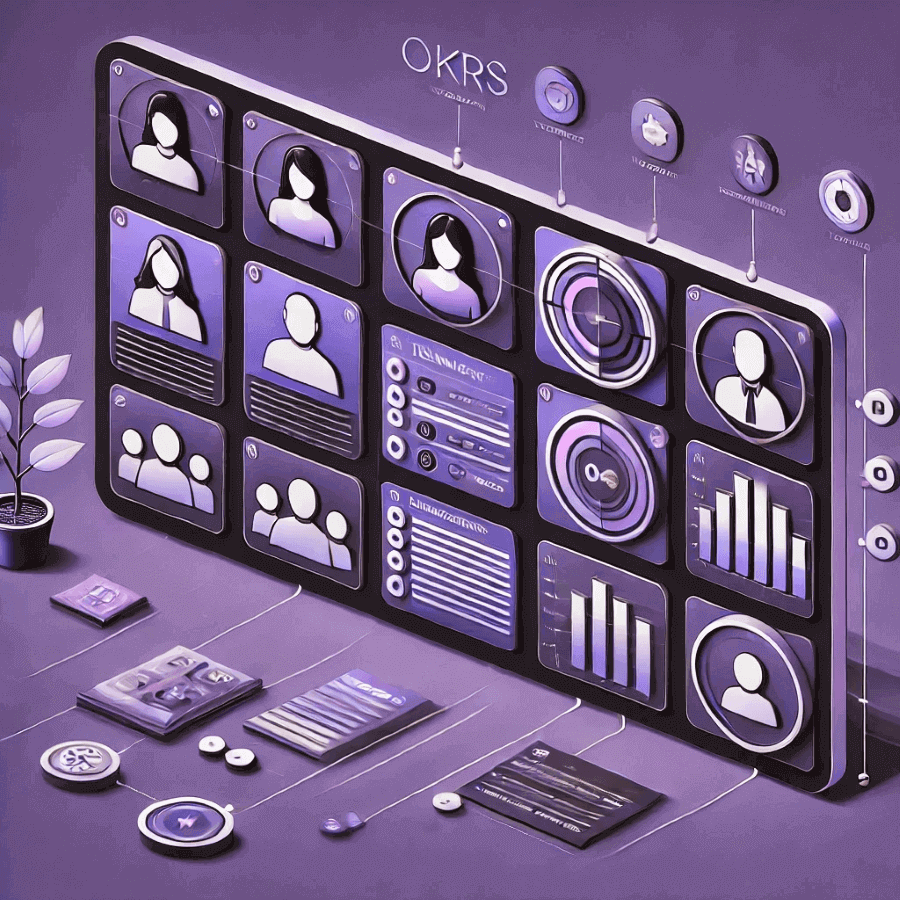
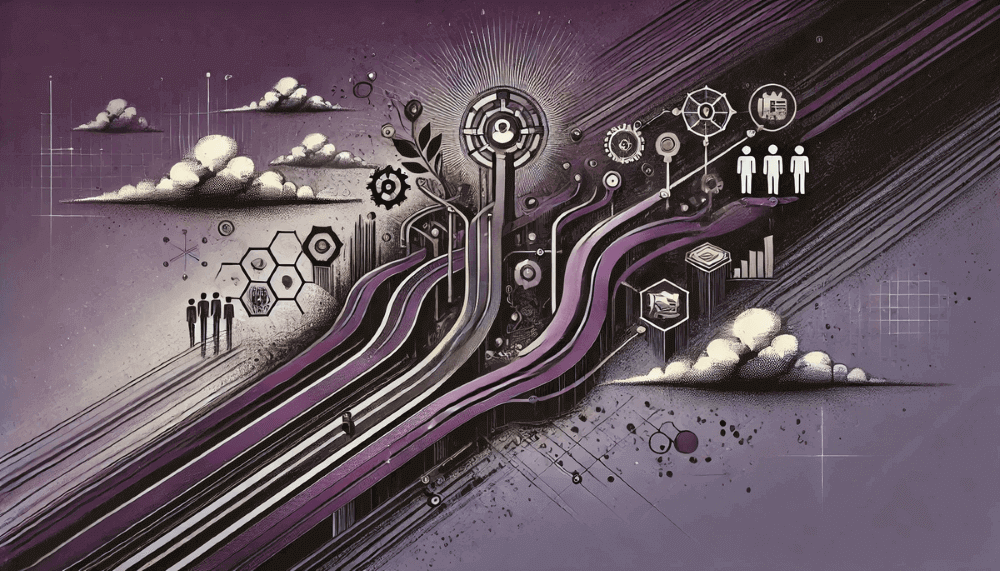
    Digital illustration of a structured team dashboard in purple and black tones, representing OKRs, collaboration, and productivity during organizational change.

    The result

    Over the next three months, our team’s satisfaction levels rebounded to 95%. We remained focused, collaborative, and productive throughout the changes. The systems and processes I introduced became reference points for other teams, and our group was consistently held up as an example of effective team culture during change.

    Scaling the production workflow

    As demand grew and the company’s client roster expanded, it became clear that our existing systems were no longer enough. We needed a new approach: one that could bring order to a complex, fast-paced workflow without adding unnecessary friction for the team. I focused on building a production system that not only improved efficiency, but also empowered the people using it.

    The challenge

    As the company scaled rapidly—serving over 30 clients with a growing editorial team—our production process needed to evolve. There were frequent delays, communication breakdowns, and a lack of visibility into who was responsible for what. The existing systems simply couldn’t keep up with the volume or complexity of the work.

    The action

    I built a ClickUp-based production system—partly from scratch and partly by refining existing elements. This included SOPs for every handoff, role-specific responsibilities, and automated workflows for assigning, reviewing, and tracking content from idea to delivery. Topics were assigned based on each writer’s experience, reliability, and availability, ensuring optimal output without burnout.

    I also created a new system to keep clients informed about their content’s production status, replacing an outdated, inconsistent process. At the same time, I established structured communication loops between the Strategy, Editorial, and Delivery teams to improve alignment and execution.

    Abstract gears and network nodes connected in a circular formation, symbolizing streamlined systems and scalable workflows.

    The result

    Turnaround time from topic approval to article readiness dropped by 35%. Writers had clearer expectations, editors experienced fewer bottlenecks, and the client delivery experience became more consistent and efficient. The team went from reactive to proactive, no longer scrambling to keep up, but setting a new operational standard.

    Building a self-sufficient team

    As my team gained confidence and the systems matured, my focus shifted from stability to autonomy. I didn’t just want a team that could execute. I wanted a team that could lead. That meant building in trust, ownership, and opportunities for growth, even during high-pressure periods.

    The challenge

    The team was functioning well, but we were still heavily reliant on me for key decisions and coordination. I knew that wasn’t scalable. If I stepped away, progress slowed. I wanted to give my team the tools, structure, and space they needed to lead independently, while still maintaining quality and accountability.

    The action

    I started by inviting each team member to take ownership of small internal projects. From managing meeting agendas to leading discussions, I gradually handed over key responsibilities. We introduced rotating leadership in our meetings and set aside 15 minutes at the end of each session for team-building and informal connection.

    I also created backup workflows and planned my time off strategically by giving team members the chance to step up without my presence. Throughout, I offered coaching in the background and created documentation that would support them whether I was there or not.

    The result

    The team rose to the challenge. Ownership increased, confidence grew, and I saw new leaders emerge. They didn’t just hold the fort. They made it better. Our team meetings became more collaborative and intentional, and the systems we built allowed for consistent delivery, even when I wasn’t in the room. Most importantly, the team continued delivering without disruption, proving that the systems and the people could stand on their own.

    A team raising trophies under falling confetti, celebrating a milestone achieved through collaboration and leadership.

    Building the automation function

    After my manager left, I became the only person with a full understanding of how our production systems worked. That included workflows the rest of the team had never been involved in, like the automations handled by a long-standing virtual assistant (VA), who had previously reported only to my manager.

    The challenge

    The VA played a critical role in generating content delivery documents through Zapier and fixing automation issues, but she operated in isolation. Requests were often ignored, communication was limited to Slack tags, and no one else had visibility into her process. Once she came under my supervision, I realized there was no documentation, no support structure, and no accountability. And more than that: the automations themselves were inefficient, fragile, and slowing us down.

    The action

    I started by creating a performance improvement plan in partnership with her agency. We outlined clear expectations, timelines, and goals, but despite agreeing on the plan, nothing changed. After repeated issues and missed responsibilities, I made the decision to offboard her.

    With no one else trained on the systems, I jumped in myself. I taught myself Zapier, reverse-engineered the workflows, and quickly found ways to simplify and streamline everything. I redesigned the entire automation process to be faster, more reliable, and less dependent on one person. Then, I created detailed SOPs so no one would ever have to scramble to figure it out again.

    When I hired a new VA for the role, everything was already documented. Even when my first candidate became unexpectedly unavailable, onboarding the next one was simple, fast, and repeatable because the system was already in place.

    A sleek, futuristic maze with a glowing pathway, symbolizing leadership, problem-solving, and structured decision-making.

    The result

    The improvements I made personally reduced automation errors by 90%, decreased the time to generate content cards by 25%, and cut our reliance on Zapier in half. More importantly, the role went from an opaque, fragile dependency to a scalable function supported by clear SOPs, structured onboarding, and shared team knowledge.

    Embracing leadership and driving innovation

    By the time I became Production Manager, I had already spent months observing how organizational dynamics and people-pleasing decisions were creating silos, redundancies, and inefficiencies across the production workflow. My early requests for clarity and shared ownership had been dismissed, so I redirected my focus into building what I could: SOPs, systems, and stability for my own team.

    The challenge

    When our client base began to shrink, we were asked to reduce budgets across the team. But cost-cutting alone wouldn’t solve the problem. I knew the real opportunity was in streamlining overlapping processes. Specifically, I suggested merging two teams that had been created to serve similar functions but operated in isolation, duplicating effort and creating avoidable delays.

    The problem was: I wasn’t in a position to make that decision yet. My new manager had recently joined, and while she was open, she had been warned that I had “conflicts” with the other team. Trust had to be earned.

    A futuristic design of interconnected gears and nodes in rich purple and lavender, symbolizing clarity, teamwork, and operational excellence.

    The action

    Instead of pushing back, I focused on delivering results. I continued improving systems, led my team with transparency, and created documentation to highlight where redundancies were costing time and resources. I proposed a long-term solution: dissolve the artificial separation between the teams and instead build client-specific content specialists who could manage end-to-end delivery and strengthen client relationships.

    It took four months, but when my manager saw the consistency of the issues—and the clarity of the solution—she approved the proposal.

    The result

    That decision marked the end of my time as Production Manager, and the beginning of a new chapter. But the foundation was already there: a culture of ownership, clear systems, and a willingness to lead change, even without permission.

    Reflecting on the journey

    Looking back, this role taught me what it really means to lead through complexity. I didn’t have all the answers, but I asked the right questions, built the right systems, and empowered the right people. I focused on operational excellence, but I also worked to shift the culture: from “not my job” to “how can I help.”

    That shift didn’t happen through force. It came through leading by example, aiming for clarity and consistency, and giving my team the tools and trust they needed to take ownership. While the role evolved beyond Production Manager, the foundation I built—systems, accountability, and people-first leadership—continues to shape how I work today.


  • People-Centered Leadership During a Department Merger

    People-Centered Leadership During a Department Merger

    When I was promoted to Head of Production, my first major challenge came fast: lead a department merger, cut costs by 65%, and keep things moving without losing people in the process. The task wasn’t just operational. It was deeply human.

    I was stepping into a situation with overlapping roles, mismatched systems, and teams that didn’t quite trust each other … or me. One team had clear documentation and structure. The other relied on memory, improvisation, and legacy habits. Everyone had questions. Most had concerns.

    This case study walks through how I led a department merger with clarity, empathy, and structure. From selection and offboarding to workflow redesign and cross-team alignment, it’s a story about how to lead change, especially when the stakes are high and the path isn’t fully paved.

    The challenge: two teams, one goal, zero alignment

    When I stepped into the Head of Production role, I inherited two separate teams: production and delivery. Months earlier, I had proposed a merger between the two as a way to reduce redundancy and improve performance, but now, due to budget constraints, it became a necessary reality.

    Both were working toward the same outcomes, but operating with entirely different workflows, communication styles, and expectations. Due to budget constraints, I was tasked with reducing the total team size from eight to four. But simply “cutting” wasn’t an option. I knew that the way we approached this would shape not only our performance, but our team culture going forward.

    The two teams had been built in parallel, with some overlap in responsibilities and little coordination between them. The production team had mature systems, detailed SOPs, and a strong sense of process ownership. The delivery team, on the other hand, lacked updated documentation and often relied on institutional knowledge and ad hoc communication. This created redundancies, delayed handoffs, and blurred accountability, especially in client-facing work.

    A close-up of interconnected purple gears, symbolizing misaligned but interdependent systems in a workflow

    Morale was also at risk. Team members didn’t know what the merger would mean for their roles or their future. I needed to lead a process that was not just efficient, but transparent and respectful. One that prioritized fairness, clarity, and care, even in the face of difficult decisions.

    The action: designing a fair and transparent merger process

    With trust and morale on the line, I knew the way we handled this merger would matter just as much as the outcome. I approached the transition like any high-stakes operations challenge: by designing a clear, structured process that prioritized fairness, transparency, and empathy at every step. From selection to offboarding to onboarding a new team, the goal was to create alignment, not just in workflow, but in purpose.

    Selection with structure and empathy

    To ensure the selection process was fair, I proposed including two additional candidates from other departments to widen the evaluation pool and reduce perceived bias. I also requested that the People & Culture Manager be involved from the start. Why? To validate the process and to serve as a point of support for any team member who had questions or concerns. Transparency wasn’t optional. It was foundational.

    I created a detailed interview framework that included a structured questionnaire and a scorecard to assess each candidate based on performance, potential, and alignment with the newly unified team’s goals. I wanted to make sure that every team member, regardless of background, was evaluated using the same criteria.

    I communicated timelines, next steps, and the decision-making structure clearly. Then I personally conducted ten one-on-one interviews, gathering not just performance data, but also personal perspectives, strengths, and support needs. The goal wasn’t just to “choose the best” team members. It was to build the right team for what we needed next.

    Onboarding and offboarding with care

    Once the final team was selected, I turned my attention to ensuring both a smooth transition and a positive offboarding experience. I developed individual offboarding plans for each departing team member, drafted communications, and coordinated closely with People & Culture to make sure no one was left in the dark. I offered personal support where needed and made space for human conversations, not just HR ones.

    Abstract illustration of people paths converging with gears and workflows, symbolizing team restructuring

    For the new merged team, I facilitated hands-on training—especially for former delivery team members, whose processes hadn’t been documented previously. I walked them through updated workflows, developed new SOPs, and ensured everyone understood not just what needed to be done, but why the changes were happening. It wasn’t about erasing what had been built before. It was about creating shared understanding and alignment moving forward.

    I was aware of how I might be perceived: coming in, taking over, and replacing their former lead. But instead of asserting authority, I focused on clarity, care, and collaboration. I told them I wasn’t there to impose a new way of doing things; I wanted to understand what they were doing, what they believed could work better, and how we could improve together. If their process worked better, I would adjust mine. Over time, resistance shifted into curiosity, and then into buy-in. They saw that I kept my word, that I listened, and that I made expectations clear. By the end of the transition, some of the same people who had felt sidelined were now thanking me for the way I handled it. That transformation, from guarded skepticism to shared ownership, was the clearest proof I could have asked for that this approach was working.

    Fixing what was broken: unifying workflows and client experience

    While merging the teams, it quickly became clear that it wasn’t just roles that needed restructuring. It was how we worked across the board. Production and delivery had been operating from separate ClickUp folders with different standards and expectations. That fragmentation created delays, duplicated work, and blurred accountability. My goal wasn’t just to unify the folders. It was to rebuild the system so that it worked, for both the team and our clients.

    We already had structured SOPs in place, built during my time as Operations Strategist. But now, the merged team required updated SOPs, reworked automations, and refined handoffs. I oversaw the redesign of those systems to reflect the new structure and ensure they supported clear ownership and efficient execution.

    One of the most important changes I implemented was a client journey system in ClickUp. It provided cross-departmental visibility into every stage of production and helped us track ownership and blockers. It was designed to ensure nothing fell through the cracks and, when something did, we could immediately identify what happened, where, and why. It shifted the culture from finger-pointing to root-cause analysis and continuous improvement.

    Futuristic digital representation of operations streamlining sales and marketing processes, symbolizing automation, efficiency, and business growth.

    At the same time, I began developing a client-facing dashboard system: a single link where each client could access everything relevant to their content: status updates, resources, delivery timelines, and more. The idea came from internal feedback: when I built a centralized SOP hub for the team to reduce friction and confusion. I wanted to give our clients the same clarity.

    The dashboard system wasn’t launched due to layoffs and leadership changes, but the vision was in place: reduce noise, increase trust, and streamline communication across the entire production lifecycle.

    Through the transition, we reduced production turnaround from 33 days to 21 without sacrificing quality. That improvement wasn’t achieved in isolation. I worked closely with department heads and directors to streamline interdependent workflows, clarify accountability, and improve handoffs across teams. One example was the Strike policy, which I co-developed with other leaders to create consistency around performance expectations and escalation paths. This collaboration helped reduce ambiguity and build a shared language for accountability, not just within production, but across the organization.

    The shift wasn’t just operational; it was cultural. By improving visibility, reducing redundancy, and reinforcing shared standards, we rebuilt trust with clients and with each other. And while some of the larger initiatives, like client dashboards, were paused due to company-wide restructuring, the foundation was there: systems that empowered teams, surfaced root issues, and laid the groundwork for long-term improvement.

    The result: impact beyond the numbers

    The outcomes of the merger went far beyond hitting budget targets. We reduced departmental costs by 65% while restoring productivity to 100% within the first month. Turnaround time for content delivery dropped from 33 to 21 days, and internal confusion gave way to clarity, collaboration, and shared ownership.

    A stylized purple path with system icons and analytics graphs, symbolizing measurable impact

    But the true result was in how the work got done. The merger didn’t fracture morale. It rebuilt it. The team transitioned from uncertainty and skepticism to trust and engagement. By leading with structure and transparency, we aligned around a new operational rhythm that empowered people instead of sidelining them.

    Cross-functional alignment improved as well. With cleaner systems and clearer expectations, our team became easier to work with and more reliable to deliver. Initiatives like the Strike policy reinforced accountability across departments and laid the groundwork for a more scalable, sustainable production model.

    I stepped into the role with a mandate to reduce headcount. But what I delivered was a stronger system, a healthier culture, and a more effective team.

    Reflecting on the journey

    This merger wasn’t just a structural change. It was a turning point in how I lead.

    I’ve always believed that systems and people should work together, not in conflict. And this experience confirmed that belief. Even in a high-stakes situation with limited time and shrinking resources, it was possible to lead with transparency, invite collaboration, and deliver real results without compromising trust.

    It taught me that change doesn’t have to feel chaotic. That clarity can be a stabilizer. That accountability, when paired with empathy, builds stronger teams, not resentful ones. And that sometimes, the most human thing you can do is build a system that makes work better for the people inside it.

  • Operational Systems Strategy for a Digital Marketing Agency

    Operational Systems Strategy for a Digital Marketing Agency

    When you think of a digital marketing agency, you likely imagine modern solutions, automated workflows, and a team that’s always leading the way. That’s what I thought too…

    A local marketing agency reached out for help in organizing their operations. Imagine my surprise when I discovered their internal processes were managed with… pens and notebooks. Yes, physical ones! 

    This wasn’t just an inefficiency issue—it was a credibility challenge. How could an agency delivering modern, digital-first solutions to clients operate with outdated systems? This disconnect was holding them back from scaling, empowering their team, and ultimately delivering on their brand promise.

    Understanding the problem: manual processes and bottlenecks

    The agency faced several critical operational challenges that hindered productivity and growth:

    Reliance on manual processes:

    Task management was primarily handled through notebooks and verbal updates. This outdated approach led to:

    • Missed deadlines due to forgotten tasks or unclear priorities.
    • Duplicated efforts as team members unknowingly worked on the same tasks.
    • Increased errors because there was no centralized system to track progress or changes.
    • Difficulty scaling operations, as manual methods couldn’t keep up with growing demands.

    Workflow visibility issues:

    The lack of transparency in workflows created significant bottlenecks:

    • The owner was overwhelmed by micro-managing tasks because there was no clear overview of who was responsible for what.
    • Delegation became nearly impossible, as team members didn’t have access to the information they needed to take ownership.
    • Hidden inefficiencies went unnoticed, such as tasks sitting idle or misaligned priorities.

    Bottlenecks across the organization:

    Without documented processes, the agency struggled to maintain smooth operations:

    • Onboarding chaos: New team members were left guessing how to perform tasks, leading to slower ramp-up times and higher frustration levels.
    • Inconsistent quality: The lack of standardized workflows meant that work quality varied significantly between team members.
    • Delayed decision-making: Critical decisions were stalled because the necessary data or context wasn’t readily available.
    • Resource constraints: Time and energy were wasted resolving recurring issues that a well-documented process could have prevented.

    The following mind map visualizes these pain points:

    A mind map outlining key operational bottlenecks in a digital agency, including reliance on manual processes, poor workflow visibility, and onboarding inefficiencies.

    The interconnected nature of these issues—manual processes feeding into visibility problems and multiplying bottlenecks—created an operational chaos.

    My approach: turning chaos into clarity

    Effective solutions start with understanding the people and workflows behind the chaos—not just jumping into tools. To do this, I asked three key questions:

    • What are you doing now? — Understanding current workflows.
    • What do you hope to achieve? — Clarifying goals, mission, and vision.
    • What’s your biggest challenge? — Pinpointing pain points and resistance to change.

    By combining insights from these conversations and my experience in systems building, I created a personalized strategy to streamline their operations. My goal wasn’t just efficiency—it was empowerment.

    Introducing scalable solutions

    Once I identified their pain points, I proposed systems that aligned with their needs. Instead of focusing on tools as a fix-all, I selected solutions that would address the root causes and scale with their growth.

    Slack – streamlining communication

    The team had relied on WhatsApp, blurring lines between work and personal life. I proposed Slack to:

    • Organize conversations: Channels for projects and clients that reduce clutter.
    • Enable threaded discussions: Keeping updates on-topic.
    • Centralize communication: With searchable history and huddle calls, communication became clear and accessible.

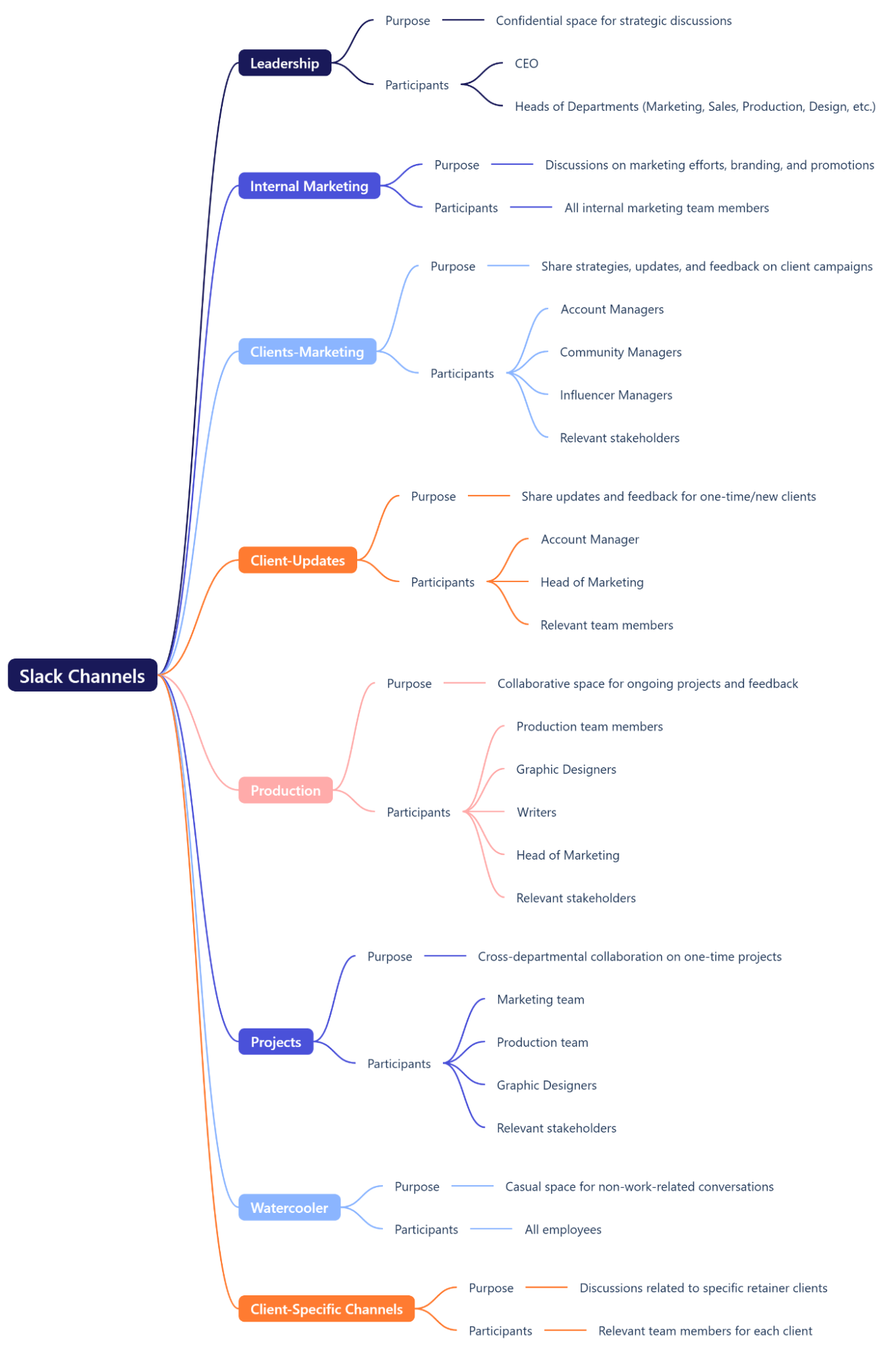
    Here is my suggestion on how they could organize their Slack channels:

    A visual breakdown of Slack channels organized by purpose and team involvement, from leadership and client updates to internal marketing and project collaboration.

    This shift aimed to improve collaboration and restore work-life balance, boosting morale.

    Google Workspace – centralizing collaboration

    Google Workspace was intended to replace a part of their notebooks through things like:

    • Google Drive: Shared drives that ensure easy access and version control.
    • Docs & Sheets: Real-time collaboration that eliminates delays.
    • Calendar Integration: Streamlined scheduling and visibility.

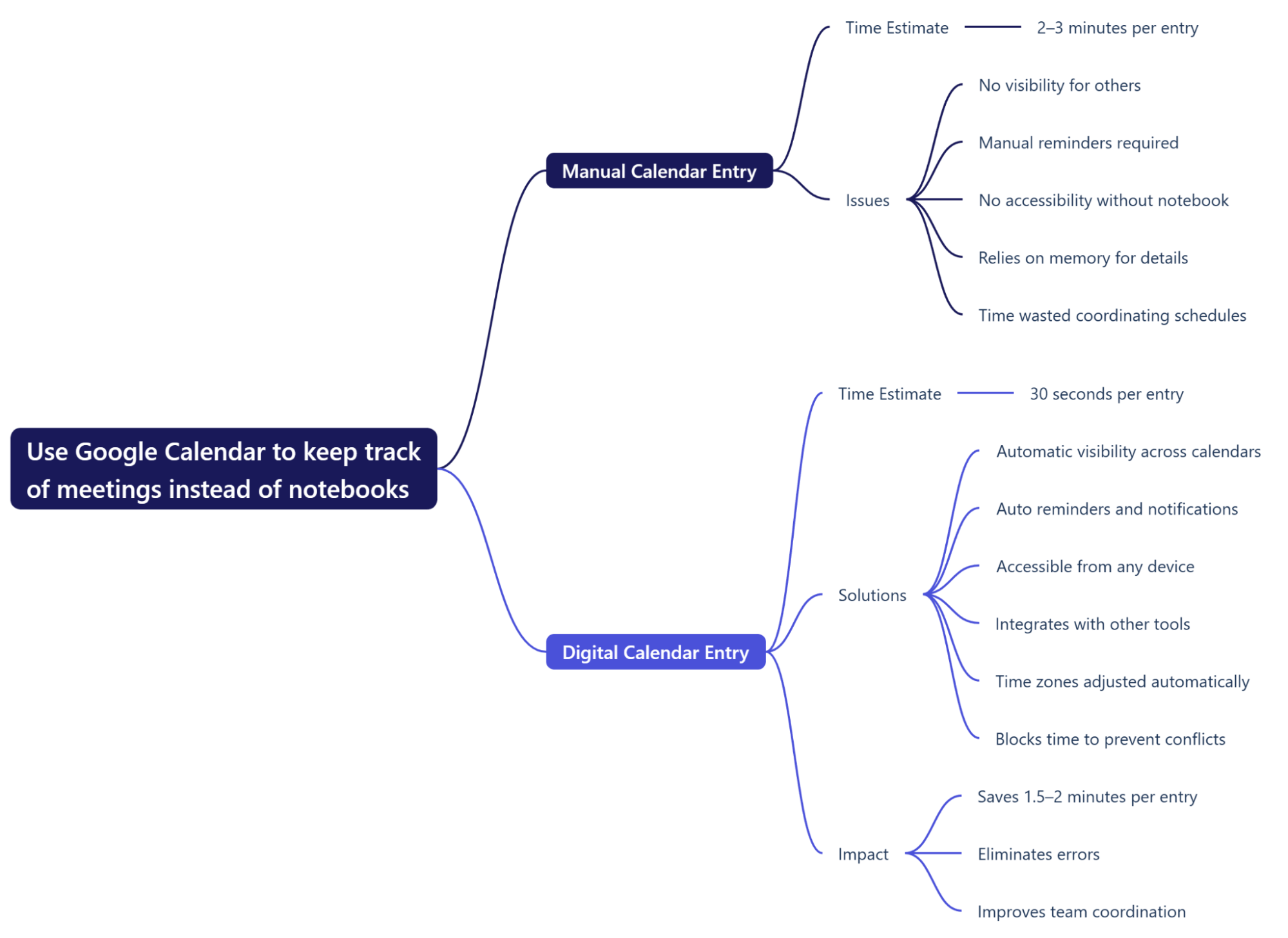
    For instance, as shown in the mind map, replacing manual meeting tracking with Google Calendar can significantly improve efficiency. The shift reduces time spent on manual entries, eliminates errors, and enhances team coordination by providing automatic visibility and reminders. With these changes, their team could focus on delivering quality work, not hunting for data.

    Below is a comparison between tracking meetings manually in a notebook, as was previously done, and utilizing Google Calendar:

    ClickUp – organizing tasks and workflows

    The other part of their notebooks would have been replaced with ClickUp, which allowed:

    • Task templates: Standardized workflows for recurring tasks.
    • Automations: Automatically assigning tasks and setting due dates.
    • Dashboards: A bird’s-eye view of progress and workload.

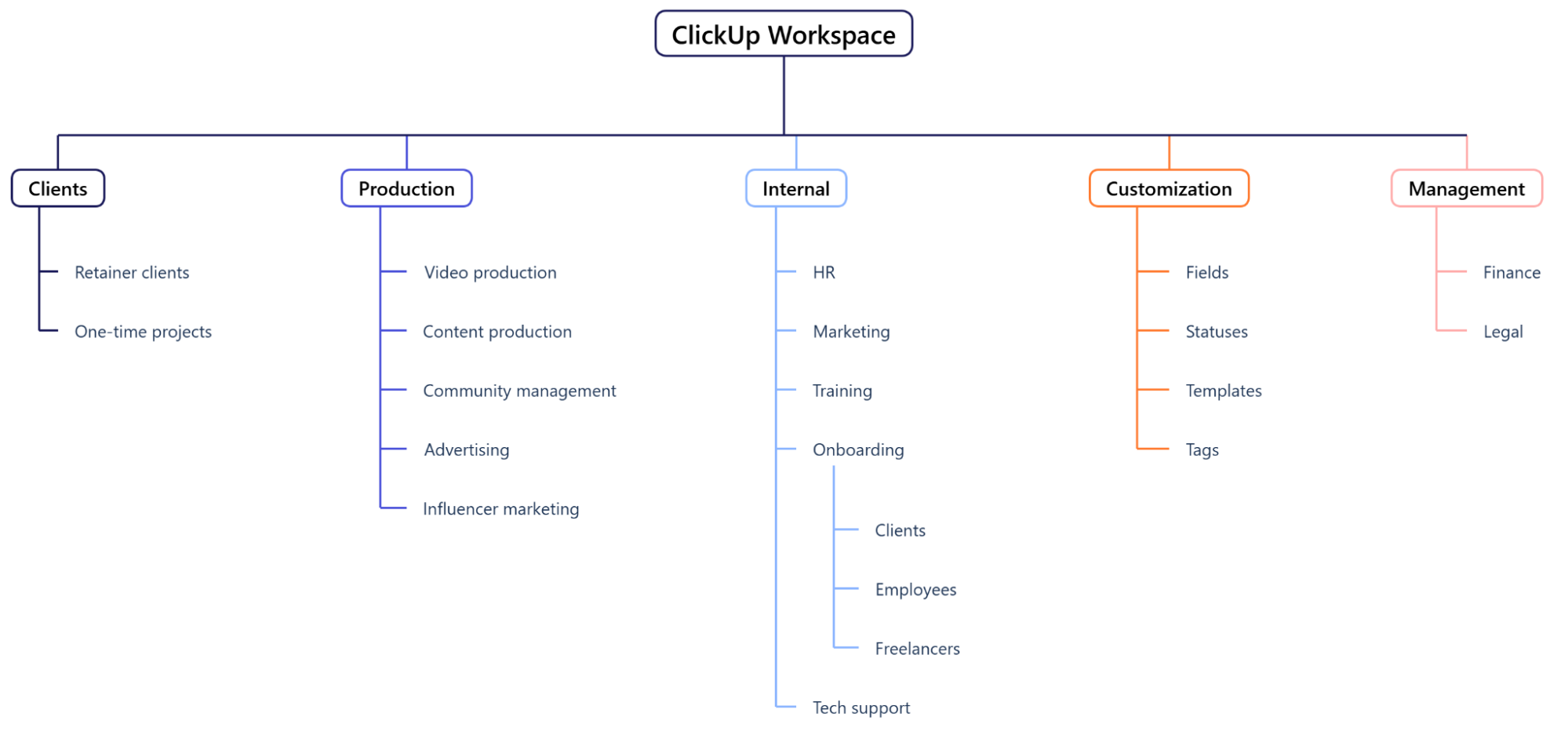
    This structure eliminated bottlenecks and enabled proactive decision-making. Here is my suggestion for their their ClickUp Workspace:

    A ClickUp workspace diagram categorizing teams and tasks by client, production, internal functions, customization, and management to improve visibility and collaboration.

    Implementation: from ideas to action

    Addressing the agency’s challenges required a dual approach: implementing scalable systems while empowering the people behind those systems. Here’s how I looked at the situation step by step, ensuring both operational efficiency and team empowerment:

    Situation:

    The agency was struggling with inefficiencies caused by manual processes, lack of workflow transparency, and operational bottlenecks. These issues not only lowered productivity but also left the team feeling overwhelmed and unsupported.

    Task:

    My goal was twofold:

    • Create scalable systems to streamline operations and improve efficiency.
    • Foster a culture of empowerment where team members could take ownership of their work and thrive in their roles.

    Action:

    To achieve these goals, I suggested the following steps:

    • Transition to Slack for communication:
      • Introduce structured channels for projects and clients, creating clarity and reducing communication overload.
      • Use Slack’s huddles and threads to enable quick, on-topic discussions, fostering collaboration without interrupting workflows.
      • Empower the team by giving them a centralized, searchable history of conversations, reducing dependency on managers for updates or context.
    • Set up ClickUp for task and workflow management:
      • Design task templates for recurring processes, ensuring consistency and efficiency.
      • Automate task assignments and due dates, allowing team members to focus on execution rather than administrative overhead.
      • Create dashboards that provide full visibility into workloads, empowering both team members and leadership to make proactive decisions.
    • Implement Google Workspace for collaboration:
      • Introduce shared drives for secure, centralized access to project files, eliminating the confusion of scattered documents.
      • Enable real-time collaboration through Google Docs and Sheets, reducing delays and errors.
      • Streamline scheduling with Google Calendar, ensuring everyone had visibility into meetings and deadlines.
    • Involve the team in the process:
      • Hold workshops to train team members on using the new tools effectively, ensuring they felt confident and supported.
      • Collect feedback from the team throughout the implementation, fine-tuning the systems to meet their specific needs.
      • Encourage open communication about challenges, fostering a sense of collaboration and ownership over the new processes.

    Result:

    The combined impact of these actions:

    • Time saved: estimated reduced time spent on manual processes by over 10 hours per week per person, freeing up the team to focus on higher-value work.
    • Improved task completion rates: standardize workflows to increase task completion rates by approximately 40%, ensuring deadlines were consistently met.
    • Enhance accountability: transparent workflows and dashboards that empower team members to take ownership of their responsibilities, improving overall accountability.
    • Boost team morale: the shift to modern tools and collaborative systems will reduce stress, improve work-life balance, and foster a culture of trust and empowerment.
    Digital illustration showing glowing arrows, gears, and a lightbulb representing growth and operational insights in a strategic roadmap.

    Additional recommendations from past experience

    Building on my prior experience, I provided further recommendations:

    • For retainer clients:
      • Use ClickUp Templates to create standardized workflows for monthly deliverables like content calendars and community management.
      • Automate task assignments and due dates based on the production stages (e.g., “To Do,” “In Progress,” “Review”).
    • For one-time projects:
      • Organize tasks by client and project type in ClickUp, with custom fields to track deadlines, deliverables, and progress.
      • Use Slack channels for project-specific communication, ensuring all updates and feedback are centralized.
    • For influencer management:
      • Create a dedicated folder in ClickUp to manage influencer sourcing, outreach, and campaign tracking.
      • Use Google Sheets for initial data collection, then integrate it into ClickUp for task assignment and progress monitoring.
    • For internal processes:
      • Set up Google Workspace for HR, legal, and finance documentation, ensuring secure and centralized access.
      • Use ClickUp’s time-tracking feature to monitor team workload and identify areas for improvement.

    Empowering the team to thrive

    One of the most significant goals of this project was to empower the team—not just to perform tasks but to excel in their roles. By addressing the operational chaos and introducing scalable systems, the team can experience a shift from firefighting to proactive ownership. Here’s how the proposal empowered the agency’s people:

    Restoring focus and reducing stress:

    With clear workflows and automated systems, team members no longer have to rely on memory or verbal updates to track tasks. This will reduce the mental load and give them the mental space to focus on delivering creative, high-quality work.

    Fostering accountability and ownership:

    Tools like ClickUp and Slack provide transparency into who was responsible for what. This clarity encourages team members to take ownership of their tasks, boosting individual accountability and fostering a sense of pride in their contributions.

    Streamlining collaboration and communication:

    By replacing WhatsApp with Slack and introducing Google Workspace, the team will have centralized platforms for communication and collaboration. This eliminates the frustration of searching for updates in scattered channels, enabling smoother teamwork and faster decision-making.

    Empowering leaders to lead:

    The owner and managers can finally step out of the weeds of micromanagement. With dashboards and automated reporting, they will gain a bird’s-eye view of operations, allowing them to focus on strategic initiatives and empowering their team to handle day-to-day responsibilities.

    Creating a culture of excellence and growth:

    Documented workflows and standardized processes will not only ensure consistent quality but also make onboarding new hires a smoother experience. New team members could ramp up quickly, contributing to a culture where everyone felt equipped and supported to succeed.

    This cultural shift can transform the agency into a more empowered, collaborative, and efficient team, setting the stage for sustainable growth and innovation.

    The results: measurable impact of scalable systems

    By introducing these solutions, I aimed for the following results:

    MetricBefore implementationAfter implementationImprovement
    Manual processesPhysical notebooks, verbal updatesAutomated workflows with modern toolsReduced by 70%
    Time spent on admin work15+ hours/week on repetitive tasks5 hours/week with automationSaved 10+ hours/week/person
    Task completion ratesInconsistent tracking, missed deadlinesStandardized workflows, higher completionIncreased by 30–40%
    Workflow transparencyMinimal visibility100% visibility with dashboardsFull transparency achieved
    Onboarding efficiencyNo documentation; weeks-long onboardingDocumented workflows reduced time to productivity by 50%Faster onboarding process

    These results prove the transformative impact of scalable systems and modern tools on team efficiency, transparency, and scalability.

    Cost vs. benefit: the ROI of scalable systems

    Implementing Slack, Google Workspace, and ClickUp, combined with expert operational leadership, is not just about improving workflows—it’s a smart investment in both time and money. Here’s how the costs stack up against the benefits:

    First-year costs and savings

    • Annual cost of tools: $1,920/year.
    • My service fee: $80,000 (one-time cost for the year).
    • Total cost (Year 1): $81,920.
    • Time saved: 10 hours per week per team member, totaling 4,160 hours annually across 8 team members.
    • Monetary value of time saved: $115,648/year (based on an average hourly rate of $27.80).
    • Net savings (Year 1): $33,728/year.
    • ROI (Year 1): 41.2%.

    Subsequent years

    • Annual cost of tools: $1,920/year.
    • Ongoing maintenance (e.g., hiring a VA): Estimated at $20,000/year.
    • Total cost (Years 2+): $21,920/year.
    • Net savings (Years 2+): $93,728/year.
    • ROI (Years 2+): 427.5%.

    Details at a glance:

    CategoryDetailsCost/Value (Year 1)Cost/Value (Years 2+)
    Tools implementedSlack (Free), Google Workspace, ClickUp$1,920/year$1,920/year
    My service feeOne-time implementation cost$80,000$0
    Ongoing maintenanceVA or minimal upkeep based on SOPs$0$20,000/year
    Time saved10 hours/week × 8 team members4,160 hours/year4,160 hours/year
    Average hourly rateBased on team roles$27.80/hour$27.80/hour
    Monetary value of timeTotal time saved × hourly rate$115,648/year$115,648/year
    Net savingsMonetary value − tool costs$33,728/year$93,728/year
    ROINet savings ÷ tool costs × 10041.2%427.5%

    Beyond the numbers:

    This isn’t just about dollars and hours. The implementation also provides significant intangible benefits:

    • Boosts team morale: Reduces stress and improves work-life balance by replacing chaotic, manual processes with clear, automated workflows.
    • Enhances client satisfaction: Deliverables become more consistent, timely, and aligned with the agency’s brand promise.
    • Prepares for growth: Scalable systems ensure the agency can expand without operational bottlenecks, setting the stage for long-term success.
    • Empowers leadership: Leaders can focus on strategic growth initiatives instead of micromanaging daily operations.

    By investing $81,920 in the first year, the agency not only unlocks $115,648 in value but also sets the stage for even greater long-term returns. In subsequent years, with only minimal maintenance costs (e.g., hiring a VA for $20,000/year), the agency will enjoy net savings of $93,728 annually and an ROI of 427.5%. This demonstrates how operational efficiency and empowerment generate sustained value over time.

    Lessons learned: empowering teams to thrive

    This project reinforced a key lesson: tools alone don’t solve problems—people do. By involving the team and aligning systems with their needs, I aim to turn chaos into clarity.

    Scaling isn’t just about implementing tools. It’s about creating a culture of empowerment, accountability, and excellence.

  • Event Engagement Strategy for a Digital Learning Platform

    Event Engagement Strategy for a Digital Learning Platform

    In today’s fast-paced digital landscape, even the most innovative platforms can struggle to engage their audiences. When I explored the challenges faced by a leading online education platform, I saw an opportunity to bridge the gap between their mission to transform lives and their low participation in online live events.

    This case study reflects my ability to identify root challenges, design scalable solutions, and empower teams to deliver measurable results. By leveraging a personalized quiz feature, I proposed a strategy that not only enhances visibility and engagement but also strengthens community ties and creates pathways for growth. This approach showcases how thoughtful operational leadership can transform complexity into opportunities for impact.

    Understanding the problem: low participation in online live events

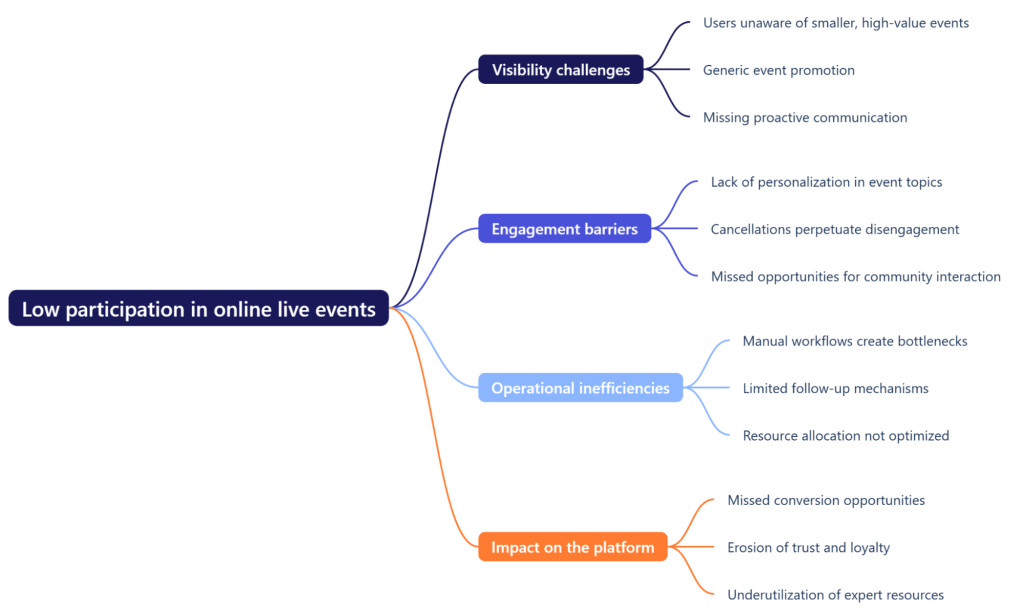
    Low participation in online live events is a multifaceted challenge that impacts both user engagement and the platform’s ability to drive conversions to higher-tier offerings. Based on my personal experience with the platform and informed assumptions, I identified three primary problem areas: visibility challenges, engagement barriers, and operational inefficiencies. Below, I’ve outlined how these issues manifest and their potential impact.

    Visibility challenges

    The lack of awareness and ineffective promotion of events are significant contributors to low participation. Specifically:

    • Users are unaware of many smaller, high-value events: While flagship events are well-publicized, smaller offerings often go unnoticed.
    • Event promotion feels generic: Unlike the personalized experience offered for mini-courses, event announcements are not tailored to individual preferences, making them less compelling.
    • Proactive communication is missing: Users must actively search for event details, as notifications and reminders are inconsistent or absent.

    Engagement barriers

    Engaging users in live events requires relevance and trust, but several factors currently hinder participation:

    • Lack of personalization in event topics: Events often feel disconnected from users’ individual goals, reducing motivation to attend.
    • Cancellations perpetuate disengagement: Events canceled due to low registrations discourage users from signing up for future opportunities.
    • Missed opportunities for community interaction: Live events are underutilized as a tool to foster connections and build a sense of belonging within the platform’s community.

    Operational inefficiencies

    Behind the scenes, operational challenges limit the scalability and effectiveness of the platform’s event offerings:

    • Manual workflows create bottlenecks: Event planning and promotion processes are likely manual, slowing responsiveness to user needs.
    • Limited follow-up mechanisms: There is no structured feedback loop to gather user insights or assess event success.
    • Resource allocation is not optimized: Events are scheduled without clear alignment to user demand, leading to wasted resources and lower ROI.

    Impact on the platform

    These challenges collectively hinder the platform’s ability to fully engage its user base and achieve its business objectives. Low participation in live events likely results in:

    • Missed conversion opportunities: Without robust participation, the platform loses a critical touchpoint to guide users toward premium offerings.
    • Erosion of trust and loyalty: Cancellations and generic experiences risk alienating users and reducing retention.
    • Underutilization of expert resources: The platform’s network of thought leaders is not leveraged effectively to showcase value or drive engagement.

    By addressing these challenges, the platform has the opportunity to significantly enhance user engagement, strengthen community ties, and create a more seamless path to higher-tier offerings. This thought process reflects my approach to identifying key issues and proposing actionable solutions.

    Mind map outlining reasons for low participation in online live events, including visibility challenges, engagement barriers, operational inefficiencies, and platform impact.

    My approach: designing a personalized, scalable solution

    To address the challenges of low participation in online live events, I proposed a personalized quiz feature designed to enhance visibility, increase engagement, and align events with user interests. The solution was guided by three core principles: personalization, scalability, and operational efficiency. Below is an overview of how each principle was to be implemented to create a holistic and impactful strategy.

    1. Personalizing the user experience

    At the heart of the solution was the goal of tailoring the event experience to individual users. By leveraging a quiz-based feature, the platform could better understand user preferences and ensure that event recommendations felt relevant and valuable.

    Key components of the personalized approach:

    • Quiz-based recommendations: Users would complete a short quiz to rank their interests across categories like career development, mindfulness, and entrepreneurship. This data would allow the platform to suggest events that aligned with their goals and aspirations.
    • Voting system: A built-in voting feature would enable users to voice their preferences for future event topics. This not only ensured alignment with user demand but also fostered a sense of ownership and collaboration within the community.
    • Targeted outreach: Personalized email campaigns and in-app notifications would deliver event recommendations directly to users, ensuring they were aware of opportunities tailored to their interests.

    By putting users at the center of the decision-making process, this approach aimed to create a more engaging and satisfying experience, while also driving higher participation rates.

    Circular digital interface with icons representing planning tools, automation, communication, and personalization surrounding a central hub, reflecting a streamlined event strategy.

    2. Building scalable systems

    To ensure the solution could grow alongside the platform, I focused on designing systems that were both sustainable and adaptable. Scalability was key to meeting increased demand without compromising quality or efficiency.

    Examples of scalable systems included:

    • Automation: By automating workflows for event scheduling, promotion, and feedback collection, the platform could reduce manual effort and free up resources for strategic initiatives.
    • Data-driven insights: Leveraging user data from the quiz and engagement metrics allowed the platform to identify high-demand topics and optimize event planning. This ensured that resources were allocated effectively and events resonated with the audience.
    • Feedback loops: A system was to be established to collect and analyze user feedback after each event. This continuous improvement cycle ensures that the platform could adapt to user needs and preferences over time.

    These scalable systems not only enhanced operational efficiency but also positioned the platform to handle future growth with ease.

    3. Empowering the team

    A people-first approach was central to the strategy, ensuring that the solution was not only efficient but also aligned with the team’s capabilities and goals. By empowering team members, the platform could foster a culture of collaboration and innovation.

    Key initiatives to empower the team included:

    • Training and onboarding: Team members were to be equipped with the tools and knowledge needed to manage the new workflows effectively. This included training on automation tools and best practices for personalized engagement.
    • Standard operating procedures (SOPs): Clear and concise SOPs were to be developed for event planning, promotion, and follow-up. These guidelines ensure consistency, accountability, and a shared understanding of expectations.
    • Technology integration: Tools like project management software were recommended to streamline operations and reduce repetitive tasks. This allows the team to focus on high-impact activities, such as creative event design and user engagement.

    By empowering the team with the right tools, training, and processes, the solution not only addressed operational challenges but also created a foundation for long-term success.

    The impact of this approach

    This personalized, scalable, and team-centric solution was designed to address the root causes of low participation in online live events. By aligning events with user preferences, building systems for growth, and empowering the team, the platform could significantly enhance user engagement, strengthen community ties, and unlock new opportunities for growth.

    Proposed solutions: a phased roadmap for growth

    To effectively implement the strategy and drive meaningful engagement, I designed a phased roadmap that balances immediate actions with long-term scalability. This approach ensures the solution evolves alongside the platform, delivering sustained impact over time.

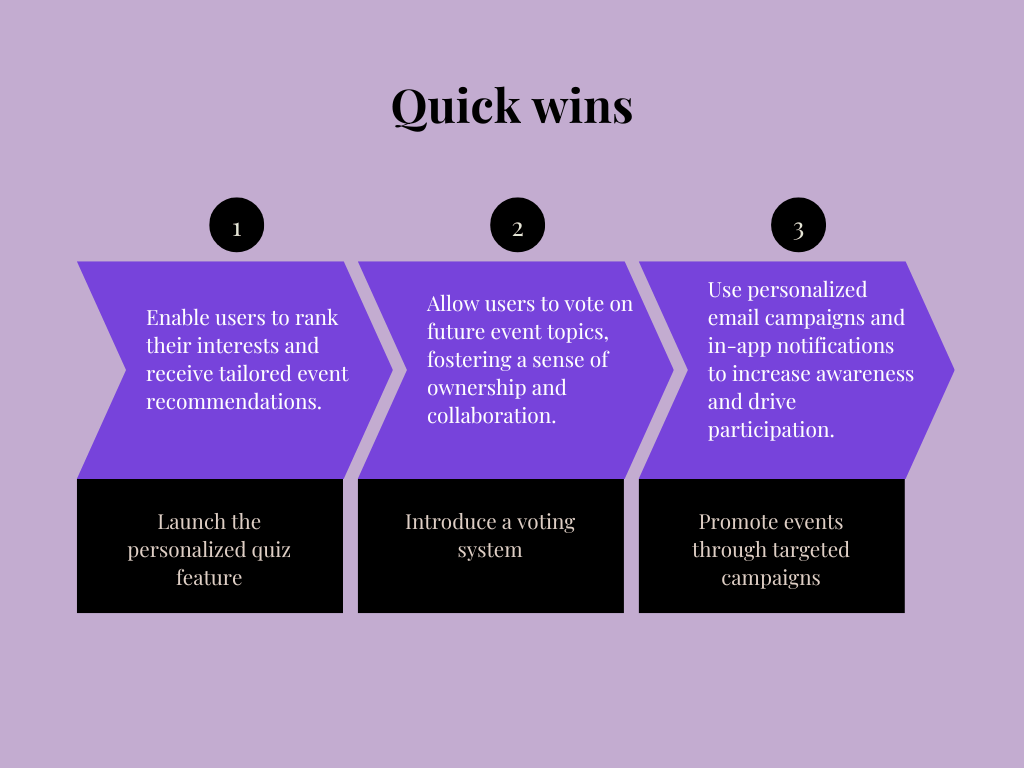
    1. Quick wins: laying the foundation

    The initial phase focuses on establishing the core components of the strategy to deliver immediate results and build momentum.

    Key actions include:

    • Launch the personalized quiz feature: Enable users to rank their interests and receive tailored event recommendations.
    • Introduce a voting system: Allow users to vote on future event topics, fostering a sense of ownership and collaboration.
    • Promote events through targeted campaigns: Use personalized email campaigns and in-app notifications to increase awareness and drive participation.

    Why this matters: These quick wins are designed to address the visibility and engagement challenges while requiring minimal resources to implement. They also serve as the foundation for the more advanced strategies in subsequent phases.

    Visual showing immediate actions such as personalized quizzes, topic voting, and targeted campaigns to drive quick engagement wins in online events.

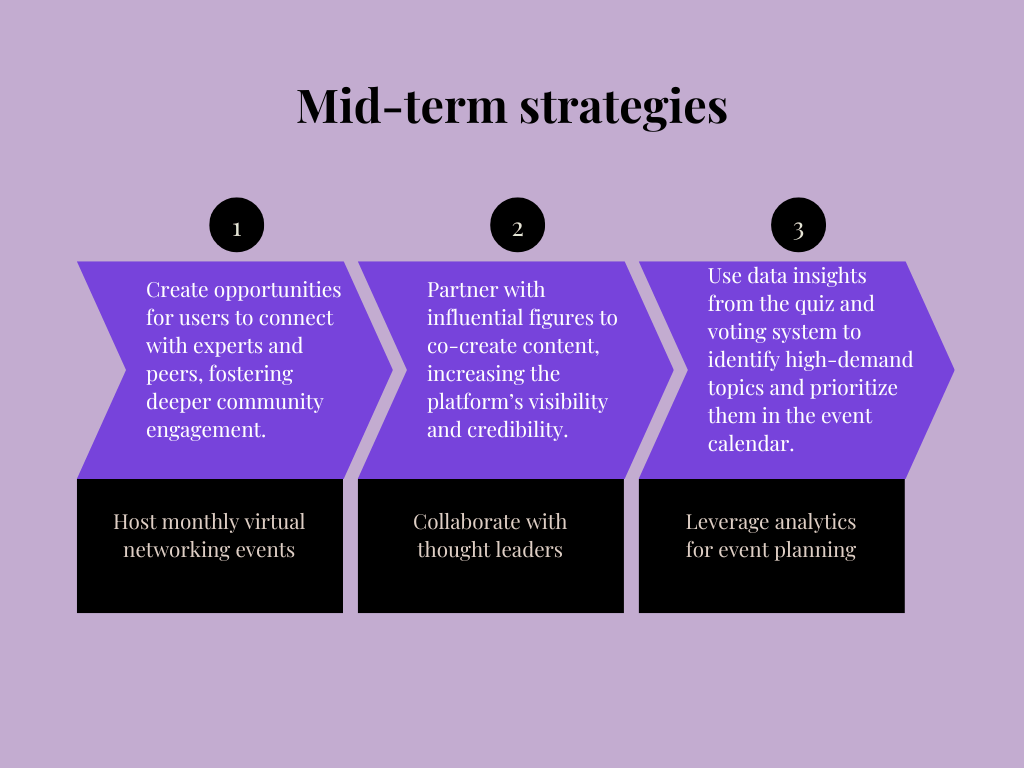
    2. Mid-term strategies: amplifying impact

    Once the foundational features are in place, the focus shifts to amplifying user engagement and expanding the platform’s reach.

    Key initiatives include:

    • Host monthly virtual networking events: Create opportunities for users to connect with experts and peers, fostering deeper community engagement.
    • Collaborate with thought leaders: Partner with influential figures to co-create content, increasing the platform’s visibility and credibility.
    • Leverage analytics for event planning: Use data insights from the quiz and voting system to identify high-demand topics and prioritize them in the event calendar.

    Why this matters: These strategies build on the initial successes by deepening user engagement and expanding the platform’s value proposition. They also position the platform as a leader in personalized, interactive learning experiences.

    Diagram outlining mid-term strategies including virtual networking, influencer collaboration, and data-driven event planning to enhance platform engagement.

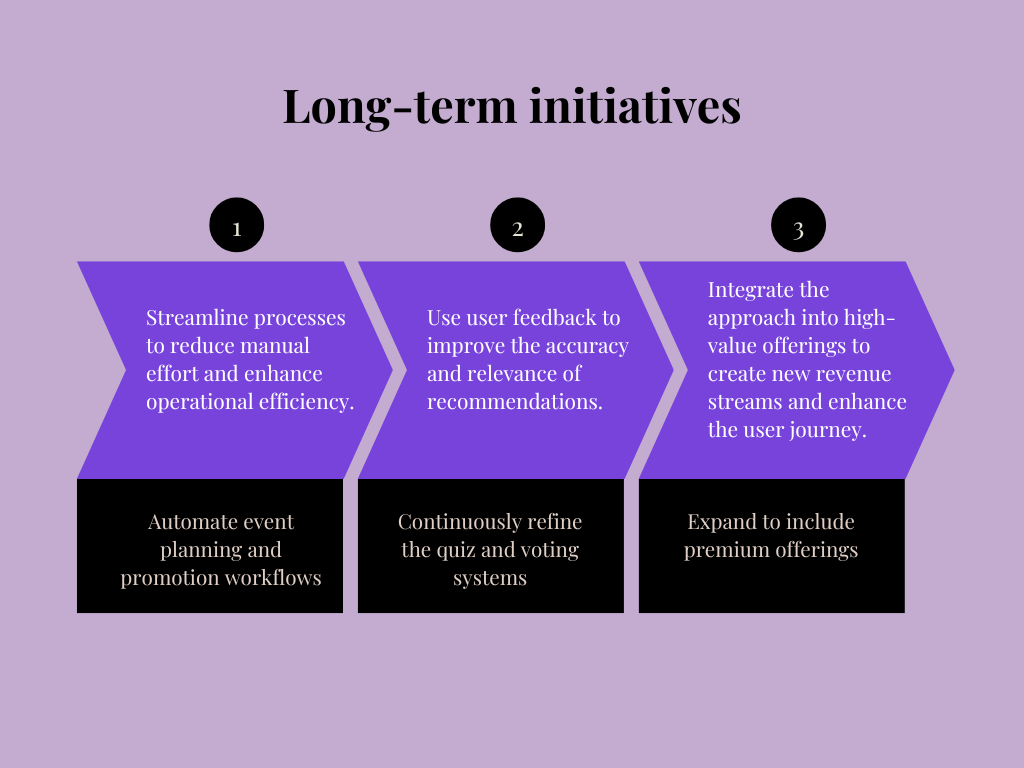
    3. Long-term initiatives: scaling for sustainability

    The final phase focuses on creating a robust, scalable system that ensures the long-term success of the strategy.

    Key initiatives include:

    • Automate event planning and promotion workflows: Streamline processes to reduce manual effort and enhance operational efficiency.
    • Continuously refine the quiz and voting systems: Use user feedback to improve the accuracy and relevance of recommendations.
    • Expand to include premium offerings: Integrate the approach into high-value offerings to create new revenue streams and enhance the user journey.

    Why this matters: Long-term initiatives ensure the platform can scale its offerings without compromising quality, while also unlocking new growth opportunities.

    Three-step visual detailing long-term plans to automate event workflows, refine recommendation tools, and integrate personalized strategies into premium offerings.

    Results: projected impact

    The proposed strategy is designed to deliver both measurable and intangible benefits, addressing the root challenges while driving growth and engagement.

    Tangible outcomes:

    These measurable results highlight the direct impact of the proposed solution on user engagement and the platform’s business objectives:

    Intangible benefits:

    Beyond measurable results, the strategy is designed to foster long-term, intangible benefits that strengthen the platform’s community and brand:

    • Strengthened community bonds: Collaborative event planning fosters a sense of belonging and shared purpose among users.
    • Enhanced brand loyalty: Demonstrating a commitment to user needs reinforces trust and loyalty.
    • Empowered users: By involving users in the decision-making process, the platform enables them to take ownership of their learning journeys.
    Futuristic illustration showing digital pathways and glowing icons representing user profiles, analytics, and communication tools, symbolizing interconnected engagement strategies.

    Transforming engagement through personalization

    This case study demonstrates how a personalized, scalable approach can transform user engagement in online education platforms. By aligning events with user interests, fostering community interaction, and streamlining operational workflows, the proposed solution reflects my ability to organize chaos, build scalable systems, and empower teams for long-term success.

    The results—both tangible and intangible—highlight how thoughtful operational strategies can unlock new opportunities for growth while strengthening trust and loyalty. At its core, this initiative isn’t just about boosting participation; it’s about inspiring excellence, fostering collaboration, and driving meaningful impact.

  • Growth Strategy for a Professional Development Organization

    Growth Strategy for a Professional Development Organization

    A professional development organization committed to connecting individuals with transformative opportunities inspired me with their mission. However, during a brief 30-minute conversation with their leadership team, it became clear they were facing significant challenges that could hinder their growth and impact.

    This wasn’t a formal consulting engagement or implementation project. Instead, it was an opportunity to offer proactive support to an organization I admired, leveraging my expertise in strategic planning, operational efficiency, and system-building. Here’s how I approached their situation to design a roadmap for sustainable growth.

    Understanding the problem: growth challenges in a mission-driven organization

    To make sure I understand what needs to be done, I asked:

    • What are you doing now?
    • What do you hope to achieve?
    • What’s your biggest challenge?

    Through this, I understood that the organization faced three core challenges:

    1. Engagement and visibility:

    • Despite their impactful mission, the organization struggled to amplify their brand and engage their community effectively.
    • They lacked structured programs to nurture advocates or ambassadors who could spread their message organically.

    2. User conversion:

    • While they had a strong base of free users, they faced difficulty converting these users into paid members or attracting enterprise clients.
    • There was no clear freemium-to-paid strategy or scalable pricing model to meet the needs of diverse user segment

    3. Operational inefficiencies:

    • Their team was stretched thin, managing multiple priorities without streamlined processes or tools to support their work.
    • This created bottlenecks and limited their ability to scale.
    Mind map visualizing key growth challenges in mission-driven organizations, including engagement, user conversion, and operational inefficiencies.

    My approach: designing a scalable strategy

    To address these challenges, I developed a comprehensive proposal rooted in three guiding principles that ensured every solution was mission-driven, scalable, and team-empowering. This approach was designed to create immediate impact while laying the foundation for sustainable, long-term growth.

    1. Align with the mission

    The heart of every recommendation was the organization’s core purpose: empowering individuals through professional development. To ensure mission alignment, I focused on strategies that directly supported the organization’s goals of fostering meaningful mentorship connections and professional growth. Examples include:

    • Referral program: Encouraging loyal users to advocate for the platform, thereby expanding the community in a way that aligns with the mission of creating a network of mentorship.
    • Ambassador program: Engaging passionate users as brand ambassadors to amplify the message of mentorship and professional empowerment.
    • Exclusive content for paid members: Developing advanced mentorship resources to provide deeper value to users, ensuring their professional development journey is enriched.

    Each initiative was evaluated through the lens of how it would further the organization’s mission, ensuring that growth did not come at the cost of the organization’s values or purpose.

    2. Focus on scalability

    Recognizing the need for sustainable growth, I designed solutions that could evolve alongside the organization. Scalability was embedded into every aspect of the strategy to ensure that as the organization expanded, its systems and processes could handle increased demand without sacrificing quality. For example:

    • Freemium-to-paid conversion strategy: This strategy emphasized building a robust pipeline for converting free users to paid members through limited-time trials, segmented email campaigns, and exclusive premium features. These efforts were designed to grow revenue without creating additional strain on resources.
    • Tiered pricing model: By creating flexible pricing tiers (Basic, Professional, and Enterprise), the organization could cater to a diverse audience, from individual users to large enterprises, while maintaining a scalable revenue model.
    • SEO and website optimization: Investing in long-term SEO strategies ensured that visibility and organic traffic would grow sustainably, reducing dependency on paid marketing efforts.

    These solutions were designed not only to address immediate needs but also to ensure that they could seamlessly adapt to future growth, providing a strong foundation for scalability.

    3. Empower the team

    A people-first approach was central to my strategy, ensuring that the solutions were not only efficient but also aligned with the team’s goals and values. By introducing tools and processes that reduced manual effort, the team was empowered to focus on high-impact work that drives results. Key initiatives included:

    • Technology integration: Tools like ClickUp for project management, ReferralCandy for tracking referrals, and ChatGPT Pro for generating branded content were recommended to streamline workflows, reduce repetitive tasks, and enhance productivity.
    • Standard operating procedures (SOPs): Comprehensive SOPs were to be developed for tasks such as content creation, email campaigns, and social media management. These SOPs will enable team members and virtual assistants to work independently with minimal oversight, ensuring consistency and efficiency.
    • Custom GPTs: Tailored AI tools were proposed to align with the branding and messaging, enabling the team to quickly generate high-quality content while maintaining the organization’s voice.
    • Training and onboarding programs: Structured onboarding and ongoing training to ensure that team members and virtual assistants were equipped with the knowledge and skills needed to excel in their roles, fostering a culture of continuous improvement.

    By empowering the team with the right tools, processes, and training, I ensured that operational efficiency was achieved without compromising the team’s well-being or alignment with organizational values.

    This comprehensive, people-first approach ensured that the solutions were not just efficient but also deeply aligned with the team’s goals, values, and the organization’s mission. By addressing challenges in a way that empowered both the team and the community, the strategy laid the groundwork for scalable, mission-driven growth, enabling the organization to thrive in the competitive mentorship landscape.

    A sleek, futuristic staircase illuminated with purple lights, symbolizing upward movement, structured growth, and strategic progress.

    Proposed solutions: a phased roadmap for growth

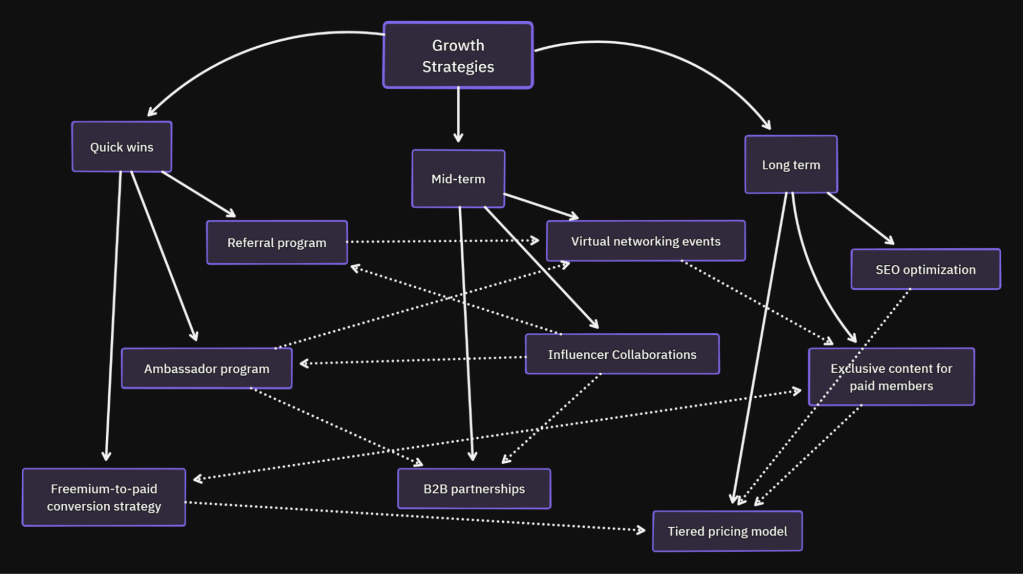
    To address these challenges, I developed actionable solutions across three phases:

    Quick wins: laying the foundation

    • Referral program: Introduce incentives for existing users to refer others, leveraging tools like ReferralCandy or Tapfiliate.
    • Ambassador program: Engage loyal users as advocates who promote the organization in exchange for rewards like early access to features.
    • Freemium-to-paid conversion: Offer limited-time trials of premium features and use targeted email campaigns to showcase their value.

    Mid-term strategies: amplifying impact

    • Virtual networking events: Host monthly events to connect users and industry experts, boosting engagement and visibility.
    • Influencer collaborations: Partner with thought leaders to co-create content and expand reach.
    • B2B partnerships: Develop pilot programs for organizations, offering mentorship as a corporate benefit.

    Long-term initiatives: scaling for sustainability

    • SEO optimization: Improve website visibility through keyword strategies and user-friendly design.
    • Exclusive paid content: Create a library of premium resources and workshops to enhance membership value.
    • Tiered pricing model: Introduce flexible pricing options to attract individual users, mid-sized teams, and enterprise clients.
    Flowchart illustrating quick wins, mid-term, and long-term growth strategies, including referral programs, SEO, partnerships, and pricing models, designed to scale mission-driven organizations.

    Implementation: from ideas to action

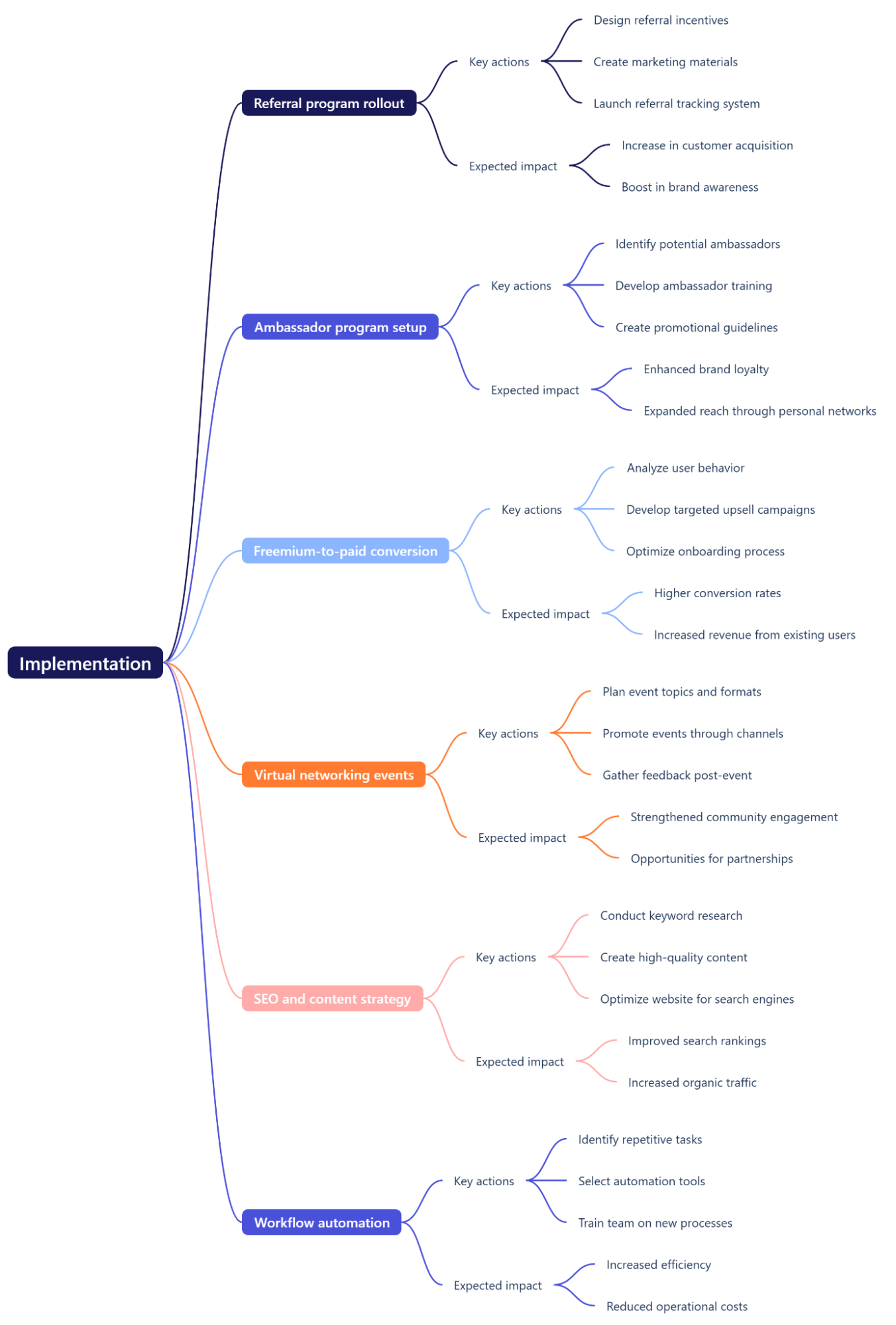
    To transform the organization’s operations and scalability, I proposed a series of actionable steps tailored to their unique needs. Each step was designed to address immediate challenges while building a foundation for long-term growth. Below is a breakdown of the initiatives and how they can be implemented effectively:

    1. Referral program rollout:

    Design a referral program to leverage the organization’s existing user base to drive growth organically. The focus is on incentivizing loyal users to bring in new members, creating a cycle of engagement and expansion.

    Key actions:

    • Tool selection and integration: Implement referral tracking software, such as ReferralCandy, to manage and analyze referrals efficiently. This includes setting up unique referral codes or links for each user.
    • Incentive design: Develop a reward structure that resonated with the target audience, offering perks such as discounts on premium memberships, free months of service, or gift cards.
    • Clear communication materials: Design email templates, social media posts, and in-app notifications to explain the program’s benefits and encourage participation.
    • Soft launch and optimization: Conduct a soft launch with a small group of users to test the program’s effectiveness, gather feedback, and make adjustments before a full rollout.

    Expected impact:

    • Increased user acquisition through organic referrals.
    • Enhanced loyalty and engagement among existing users.

    2. Ambassador program setup:

    Design an ambassador program that is aimed at turning the most passionate users into advocates for the brand, amplifying visibility and building trust within the community.

    Key actions:

    • Ambassador identification: Develop selection criteria to identify loyal and engaged users who aligned with the organization’s mission.
    • Role definition: Outline ambassador responsibilities, such as sharing content, participating in events, and promoting the brand within their networks.
    • Incentive structure: Offer rewards like exclusive content, branded merchandise, early access to new features, and gamification elements such as badges and leaderboards.
    • Onboarding and training: Create an onboarding process to educate ambassadors about the organization’s values, voice, and promotional best practices.

    Expected impact:

    • Strengthened community engagement and advocacy.
    • Increased brand visibility through authentic, user-driven promotion.

    3. Freemium-to-paid conversion:

    To convert free users into paying members, focus on showcasing the value of premium features and creating a seamless upgrade process.

    Key actions:

    • Targeted email campaigns: Design segmented email campaigns highlighting the unique benefits of premium memberships, tailored to users’ professional backgrounds and interests.
    • Time-limited trials: Offer free trials of premium features (e.g., 14 or 30 days) to allow users to experience the value firsthand, with follow-up campaigns to encourage upgrades.
    • Upselling through content: Create in-app and email content that demonstrates how premium features could solve specific pain points or enhance users’ professional development.

    Expected impact:

    • Boosted conversion rates from free to paid users.
    • Increased revenue while maintaining user satisfaction.
    A tree made of gears and cogs against a purple background, representing systems thinking, scalable growth, and interconnected strategies.

    4. Virtual networking events:

    Hosting virtual networking events as a strategic move to foster community engagement, position the organization as an industry leader, and provide value to users.

    Key actions:

    • Event planning: Schedule monthly events featuring industry experts, roundtable discussions, and Q&A sessions. Event topics should be aligned with users’ interests and professional goals.
    • Platform selection: Choose interactive platforms like Zoom to facilitate engagement through breakout rooms, polls, and live Q&A.
    • Promotion: Use email marketing, social media, and ambassador outreach to drive attendance and create buzz around the events.
    • Post-event engagement: Share event recordings and key takeaways with attendees and the broader community to extend the value of the sessions.

    Expected impact:

    • Strengthened user connections and engagement.
    • Enhanced the organization’s reputation as a thought leader in mentorship and professional development.

    5. SEO and content strategy:

    A robust SEO and content strategy should be developed to increase the organization’s visibility, drive organic traffic, and establish authority in the mentorship space.

    Key actions:

    • Keyword research: Conduct in-depth research to identify high-impact keywords related to mentorship, career growth, and professional development.
    • Content calendar: Create a blog content calendar focused on topics relevant to the target audience, such as mentorship success stories, career tips, and industry trends.
    • On-page optimization: Optimize website content, meta descriptions, and alt text to improve search engine rankings.
    • Guest blogging: Collaborate with industry experts and influencers to contribute guest posts, expanding reach and building backlinks.

    Expected impact:

    • Increased organic traffic to the website.
    • Enhanced brand authority and credibility.

    6. Workflow automation:

    To streamline operations and improve efficiency, we can introduce workflow automation tools and processes. This will allow the team to focus on high-impact work rather than repetitive tasks.

    Key actions:

    • Tool implementation: Roll out tools like ClickUp for project management, ReferralCandy for referral tracking, and ChatGPT Pro for content generation.
    • Standardized templates: Create task templates for recurring processes such as content creation, email campaigns, and event planning.
    • Training and adoption: Conduct training sessions to ensure smooth adoption of the tools, empowering the team to use them effectively.
    • Monitoring and optimization: Establish KPIs to measure the effectiveness of the tools and processes, making data-driven adjustments as needed.

    Expected impact:

    • Reduced manual effort and operational inefficiencies.
    • Improved team productivity and focus on strategic initiatives.
    Mind map outlining key actions and expected impact for implementing growth strategies, including referral programs, freemium conversion, networking events, SEO, and workflow automation.

    Projected impact: measurable outcomes

    Implementing operational changes requires a clear understanding of the anticipated outcomes to ensure alignment with organizational goals and maximize return on investment. By leveraging industry benchmarks, proven strategies, and scalable systems, the following measurable outcomes were projected across key operational areas:

    MetricBaseline (Industry average)Projected outcomeSource/Benchmark
    Cost per acquisitionAverage reduction of 20-30% with referral programsUp to 25% reduction in acquisition costsHarvard Business Review: Referral Program Economics
    Revenue growth potentialFreemium-to-paid models see conversion uplifts of 2x20-30% increase in recurring revenueHubSpot: Freemium Pricing Strategy
    Customer retention ratesOpenView SaaS Benchmarks: SaaS Revenue Benchmarks10-20% improvement with loyalty programs and exclusive contentSaaS Capital: Retention Benchmarks

    The numbers tell a story

    The projected outcomes highlight the transformative power of a structured, data-driven approach to operations leadership. By organizing chaos, building scalable systems, and fostering a culture of empowerment, these strategies deliver measurable results that directly impact organizational growth, efficiency, and team morale.

    Here is how:

    • Streamlined workflows: Automation and process optimization can save over $100,000 annually in operational costs by reducing manual tasks and inefficiencies.
    • Doubling conversion rates: A well-executed freemium-to-paid strategy could result in a 2x uplift in conversion rates, driving significant revenue growth.
    • Improved retention: Loyalty programs and exclusive content can boost customer retention by 10-20%, fostering long-term relationships and reducing churn.

    Results and outlook

    By implementing these solutions, the organization can streamline operations, improve user engagement, and establish a scalable foundation for sustainable growth. Each initiative is tailored to align with the organization’s mission and values, ensuring that the impact was not only measurable but also meaningful.

    This data-driven, people-first approach to operations leadership not only delivers measurable outcomes but also fosters a culture of excellence and empowerment, enabling organizations to thrive in competitive landscapes.

  • LinkedIn Content Strategy with AI

    LinkedIn Content Strategy with AI

    In today’s professional landscape, LinkedIn isn’t just a platform; it’s a stage for thought leadership, networking, and career growth. But here’s the catch: maintaining a consistent, impactful LinkedIn presence is no small feat. Between tight schedules, creative blocks, and the sheer effort of crafting posts that resonate, many professionals find themselves struggling to keep up.

    I found myself in this exact position at the end of 2024. As someone passionate about operational efficiency and process optimization, I knew there had to be a better way. Enter the LinkedIn Content Factory: a scalable, AI-powered system designed to streamline content creation while preserving the human touch. This post dives into the challenges I faced, the solution I built, and the results it delivered.

    The problem: why LinkedIn content creation feels overwhelming

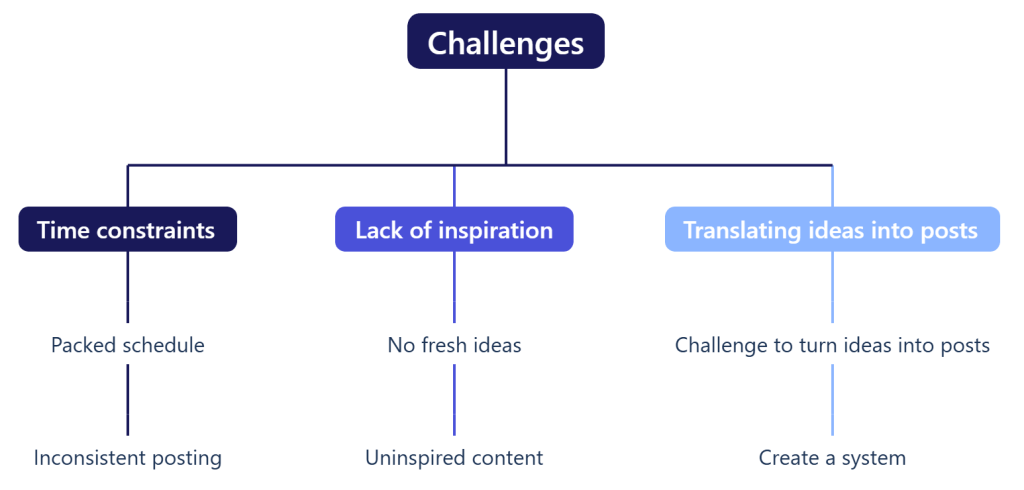
    Creating LinkedIn content isn’t just about writing. It’s about strategy, consistency, and engagement. Here are the three main challenges I encountered:

    1. Time constraints

    • Like many professionals, I had a packed schedule that left little room for brainstorming and drafting posts.
    • The result? Inconsistent posting and missed opportunities to engage with my network.

    2. Lack of inspiration

    • Coming up with fresh ideas regularly felt like a creative drain.
    • Without a structured approach, it was easy to fall into the trap of repetitive or uninspired content.

    3. Translating ideas into posts

    • Even when I had ideas, turning them into concise, engaging posts that resonated with my audience was a challenge.
    • I needed a system that could bridge the gap between raw ideas and polished content.

    These challenges aren’t unique to me. They’re common paint points for professionals and teams alike. And they presented a clear opportunity to innovate.

    Diagram showing three key challenges in LinkedIn content creation: time constraints, lack of inspiration, and difficulty translating ideas into posts.

    The opportunity: bridging AI and authenticity

    AI tools like ChatGPT have revolutionized content creation, offering speed and scalability. But here’s the thing: AI-generated content, while efficient, often lacks the authenticity and nuance that resonate with LinkedIn audiences.

    To be transparent, the concept of a LinkedIn Content Factory isn’t entirely my own. I first learned about this system from Jan Koch through his “AI LinkedIn Content Factory” course, which was part of a bundle I completed at Creator School. The bundle offered valuable insights into AI, marketing, sales, and content creation.

    That said, I noticed a critical gap in the process: personal input. One common complaint I’ve seen on LinkedIn is that AI-generated content often feels impersonal and fails to add real value. So, while Jan’s framework provided the foundation, my contribution was to refine the system by emphasizing the importance of personalization.

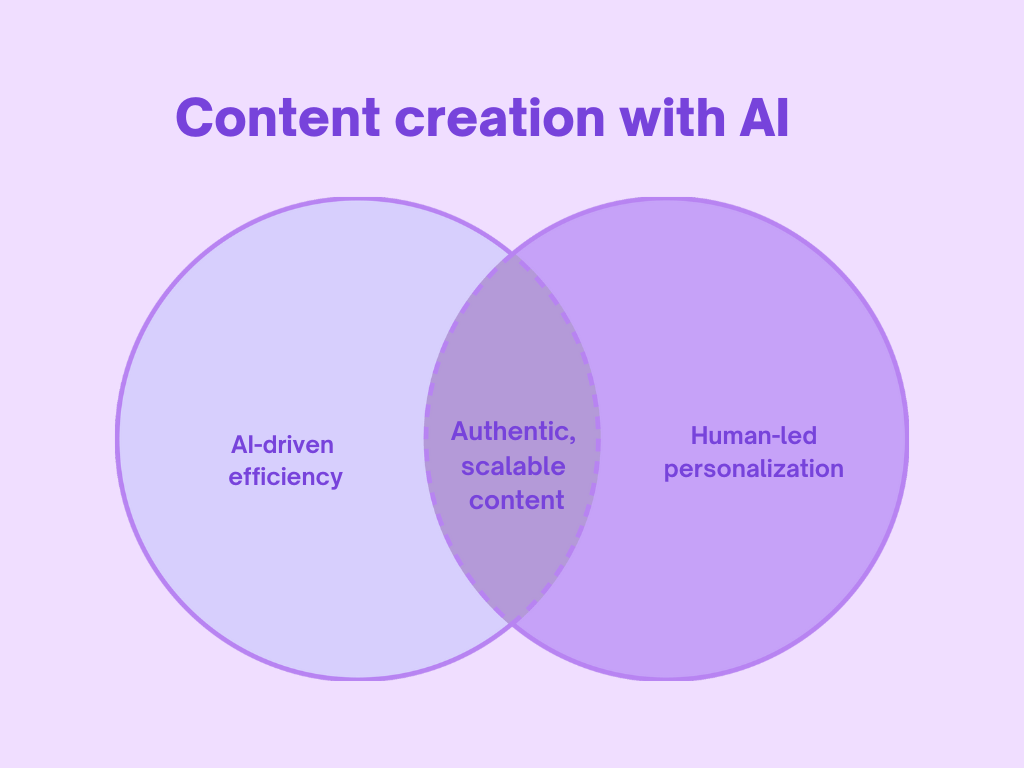
    The opportunity lay in combining the best of both worlds:

    • AI-driven efficiency: Automating repetitive tasks like idea generation and drafting.
    • Human-led personalization: Adding the personal touch that makes content relatable and engaging.

    This balance became the cornerstone of my approach to the LinkedIn Content Factory: a system that leverages AI for efficiency while ensuring every post feels authentic, valuable, and aligned with my personal brand.

    The solution: the LinkedIn content factory

    The LinkedIn Content Factory is more than just a workflow. It’s a philosophy for scalable content creation that balances efficiency with authenticity. Here’s how it works, step by step:

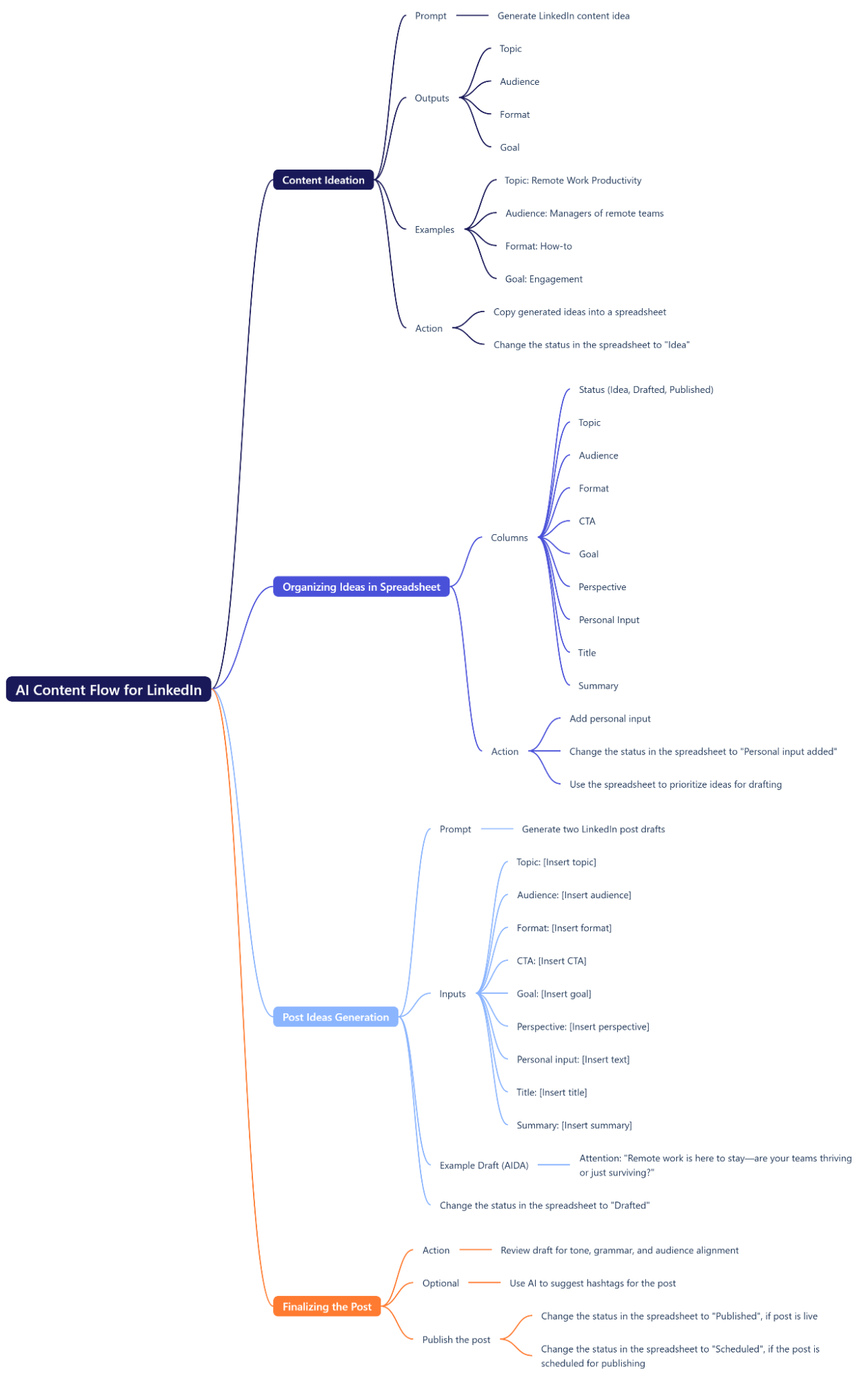
    Step 1: Content ideation

    The process begins with AI-powered brainstorming to generate a robust list of content ideas. Using a tailored prompt, I guide the AI to produce ideas that align with my audience, goals, and personal brand.

    Prompt:

    Generate 20 content ideas for my LinkedIn posts. Use the following format and options:

    Status: Idea

    Topic: [Insert topic, e.g., AI in Operations, Leadership, Remote Work, etc.]

    Audience: [Insert audience, e.g., Startup founders, Operations managers, Remote team managers, etc.]

    Format: Choose one from Reflective, Storytelling, Listicle, How-to/Actionable advice, Thought leadership, Repost with commentary, Poll/Question.

    CTA: Choose one from Comment, Start conversation, Reflect on question, Share, Visit portfolio.

    Goal: Choose one from Thought leadership, Show expertise, Network, Engagement, Conversation.

    Perspective: Provide a unique perspective for each idea based on the topic and audience.

    Personal Input: Leave this blank

    Title: Create a clear and engaging title for each idea.

    Summary: Write a 1-2 sentence summary for each idea.

    Post: Leave this blank.

    Hashtags: Suggest 3-5 relevant hashtags for each idea.

    Publish Date: Leave this blank.

    Metrics: Leave this blank.

    Repurpose: Leave this blank.

    Ensure the output is formatted as a table or list matching this column order for easy copying into the spreadsheet.

    The AI generates outputs formatted as a table or list, making it easy to copy the ideas into a spreadsheet for tracking and prioritization.

    Output example:

    Table showing structured AI input for a LinkedIn content idea, including fields like topic, audience, format, title, summary, and hashtags.

    Important disclaimer: My GPT uses custom instructions and is already trained on my tone, goals, and style. If you want to use this system, make sure to personalize it to your own voice and objectives.

    Step 2: Adding personal input

    This is where the magic happens and where I add the most value. After the AI generates ideas, I revisit the spreadsheet and focus on the Personal Input column. For each idea, I contribute my unique perspective, thoughts, or advice. This step transforms generic AI-generated ideas into posts that reflect my voice, expertise, and authenticity.

    Example:

    • Topic: Process Optimization
    • Perspective: SOPs Are Key
    • Personal input: “”Are you the kind of person that when you buy something you study the user manual before trying the product or are you throwing the manual in the garbage just to retrieve it later? To me…”
    • Title: The Secret to Scaling Without Chaos
    • Summary: Struggling with inefficiency in your startup? SOPs are the answer. Here’s why they matter and how to start.

    This step ensures that every post includes my point of view, actionable insights, and relatable anecdotes. It’s the personalization that makes the content truly resonate with my audience.

    By addressing this step, I tackle a common complaint I’ve seen on LinkedIn: AI-generated content that feels impersonal or lacks depth. Adding my input bridges the gap between efficiency and authenticity.

    Step 3: Adding missing details

    Sometimes, I already know exactly what I want to talk about or have a strong starting point. In these cases, I either build on parts of what the AI generated or create a completely new entry based on my own input. When this happens, I use a tailored prompt to help fill in any missing details and ensure the idea is fully fleshed out. I insert my input wherever I have it, and let AI handle the gaps, preparing the content for the drafting phase.

    Prompt:

    I have a content idea for LinkedIn. Here are the details:

    Topic: [Insert topic]

    Audience: [Insert audience]

    Format: [Insert format]

    CTA: [Insert CTA]

    Goal: [Insert goal]

    Perspective: [Insert perspective]

    Personal Input: [Insert text, if available. If not, leave blank.]

    Title: [Insert title]

    Summary: [Insert summary]

    Please refine this idea, complete the missing fields, and format it for my spreadsheet. The spreadsheet has the following columns, so ensure the output matches this structure:

    Status: [If blank, set as “Idea”; If not blank, set as “Personal input added”]

    Topic: Use the provided topic.

    Audience: Use the provided audience.

    Format: Choose one from Reflective, Storytelling, Listicle, How-to/Actionable advice, Thought leadership, Repost with commentary, Poll/Question.

    CTA: Choose one from Comment, Start conversation, Reflect on question, Share, Visit portfolio.

    Goal: Choose one from Thought leadership, Show expertise, Network, Engagement, Conversation.

    Perspective: Use the provided perspective or generate one if missing.

    Personal Input: Use the provided input or leave blank if unavailable.

    Title: Use the provided title or refine it if needed.

    Summary: Use the provided summary or refine it if needed.

    Post: Leave this blank.

    Hashtags: Suggest 3-5 relevant hashtags.

    Publish Date: Leave this blank.

    Metrics: Leave this blank.

    Repurpose: Leave this blank.

    Ensure the output is formatted as a table or list matching this column order for easy copying into the spreadsheet.

    Step 4: Drafting the post

    With all the details in place, it’s time to bring the post to life. This step is where the ideas and inputs from the previous stages come together into a cohesive draft. I use AI to structure and draft the post, leveraging proven frameworks that ensure the content is engaging, clear, and aligned with my goals.

    The AI helps me organize my thoughts and create a strong narrative, but it’s not just about automation. It’s about using the right tools to amplify my voice and ideas. By combining my personal input with AI’s efficiency, I can focus on crafting posts that resonate with my audience and drive meaningful engagement.

    Stylized illustration of a professional inputting ideas into a computer, with a glowing AI assistant across the desk shaping the content into a structured format.

    To guide the AI, I use a tailored prompt that ensures the draft reflects my tone, style, and intent. Here’s the exact prompt I use to generate the drafts:

    Prompt:

    I have a content idea for LinkedIn. Here are the details:

    Topic: [Insert topic]

    Audience: [Insert audience]

    Perspective: [Insert perspective]

    Personal input: [Insert text]

    Title: [Insert title]

    Summary: [Insert summary]

    Provide two alternative drafts using the best frameworks or approaches for the post, a different one in each post. Make them ready for copy-paste, along with a title, summary, and hashtags.

    Use these frameworks as optional guides:

    AIDA (Attention, Interest, Desire, Action): Focus on grabbing attention, building interest, creating desire, and driving action.

    PAS (Problem, Agitation, Solution): Highlight the problem, agitate the pain point, and provide a solution.

    RIVET: Use vivid examples or storytelling to captivate and engage the audience.

    STAR (Situation, Task, Action, Result): Use a real-world example to outline a situation, task, action taken, and result achieved.

    Voice and Style Guide:

    Use simple language to make complex ideas easy to understand.

    Start with a humorous, thought-provoking, or status-quo-challenging statement.

    Use metaphors, analogies, or everyday examples to explain complex topics.

    Write concise sentences and avoid jargon.

    Include emojis to break up text while staying professional.

    End with a CTA or branded signature.

    Step 5: Finalizing and publishing the post

    The final step is all about polish and precision, transforming a solid draft into a LinkedIn-ready post. At this stage, AI generated two drafts based on my input. Then, I carefully review both drafts, identifying what works and what doesn’t. I provide specific feedback, highlighting the strengths of each draft and requesting a new version that incorporates my suggestions.

    Once I have a refined draft, I make small tweaks to ensure the post reflects my voice and aligns perfectly with my goals. This includes adding any final touches, adjusting the tone or structure, and formatting the post for LinkedIn.

    With this system, I aim to spend no more than 15 minutes per post. Here’s how I break it down:

    • 5 minutes to add my personal input.
    • 5 minutes to review, edit, and refine the draft.
    • 5 minutes to provide feedback and finalize the post for LinkedIn.

    By keeping the process efficient and structured, I ensure each post is high-quality, authentic, and ready to engage my audience without overthinking or overworking.

    Illustration of a central AI-powered content factory connected to various digital elements, symbolizing an automated and scalable content system.

    Content planning

    To boost efficiency, I dedicate a few hours each month to prepare content for the entire month. Currently, my goal is to post twice per week, which means I need a maximum of 20 posts per month. Using this system, I estimate it will take me about four to five hours to prepare all the posts.

    Once the posts are ready, I have two options:

    • Schedule them in advance: I can schedule each post directly on LinkedIn or use a scheduling tool to automate the process.
    • Publish as needed: Even without scheduling, I can have a new post live on LinkedIn in under 10 minutes since everything is already prepared.

    The best part? Because I’ve already taken the time to add personal input (often more than I’ll use in a single LinkedIn post), I can easily repurpose the content for other platforms, such as my portfolio or blog.

    To help you get started, here’s a content plan template you can use to track and organize your LinkedIn posts. Make your own copy, customize the dropdown menus to fit your goals, and adapt the prompts in the “Prompts” tab to reflect your unique voice and style. Just remember to set up your AI tools to write in your voice or include a few descriptive lines about your tone and style in each prompt.

    Key features and innovations

    What makes the LinkedIn Content Factory unique? Here are the standout features that set it apart:

    • Framework integration: Proven frameworks like AIDA (Attention, Interest, Desire, Action) and PAS (Problem, Agitation, Solution) ensure posts are clear, structured, and action-oriented.
    • Alternative drafts for creativity: For each idea, the system generates two drafts with different tones or perspectives, fostering creative exploration.
    • Voice and style guide: A detailed guide ensures consistency, making posts both conversational and professional.
    • Audience-specific content: Posts are tailored to the needs of the people you want to reach, focusing on thought leadership and actionable insights.
    • Efficiency gains: The system reduces content creation time by at least 50%, enabling a consistent posting schedule without overwhelming the user.
    Venn diagram showing the overlap between AI-driven efficiency and human-led personalization, with the center labeled "Authentic, scalable content."

    Results and impact

    The LinkedIn Content Factory has delivered measurable results:

    • Efficiency: Reduced content creation time from one hour to about 15 minutes.
    • Scalability: Enabled the production of ~20 posts per month, maintaining a consistent posting cadence.
    • Personal impact: Helped me triple my profile views and build meaningful connections with my network.
    Flowchart illustrating the AI-assisted content creation process for LinkedIn, including steps like ideation, organizing in a spreadsheet, generating drafts, and finalizing posts.

    Future enhancements: automating with Zapier

    To make the system even more efficient, I’m exploring ways to integrate Zapier to automate repetitive tasks.

    Here’s how the enhanced process would look:

    • Idea generation: AI generates content ideas, which are automatically added to a spreadsheet via Zapier.
    • Draft creation: Zapier triggers the generation of post drafts, ready for review.
    • Personalization: I add my personal input to ensure each post is unique and authentic.
    • Finalization and publishing: Posts are finalized and seamlessly published.

    Benefits of automation:

    • Time savings: Automates manual tasks, saving hours each week.
    • Scalability: Handles higher volumes of content effortlessly.
    • Seamless workflow: Connects AI tools, spreadsheets, and publishing platforms for a fully automated process.
    Flowchart showing an AI-powered LinkedIn content creation system with Zapier integration, covering content ideation, spreadsheet organization, automated draft generation, and post scheduling.

    Lessons learned

    This project has taught me valuable lessons about the intersection of technology, creativity, and strategy:

    • Automation needs a human touch: AI can handle repetitive tasks, but human oversight ensures content feels authentic and valuable.
    • Frameworks matter: Using frameworks like AIDA and PAS provided structure, making it easier to create posts that resonate.
    • Audience-centric content wins: Understanding your audience’s pain points and preferences is key to creating content that drives engagement.

    💬I’d love to hear your thoughts! Does this system work for you? If you’ve tried it, let me know how it’s helping or how it could improve.

    You can also check out my LinkedIn profile to see my posts in action. Let me know how “AI-generated” they sound and share any feedback you have. One suggestion I’ve already received is to vary the structure of my posts, which I plan to implement soon.

    Author’s Note – Q1 Reflection
    This post was originally written in early January 2025, right as I began implementing the LinkedIn Content Factory system. Since then, I’ve tested it in real-world conditions, reflected on what worked, and iterated on the process. At the end of Q1, I reviewed the data and feedback to refine my approach and I’ve got a few exciting updates I’ll be sharing in an upcoming post.