
When you think of a digital marketing agency, you likely imagine modern solutions, automated workflows, and a team that’s always leading the way. That’s what I thought too…
A local marketing agency reached out for help in organizing their operations. Imagine my surprise when I discovered their internal processes were managed with… pens and notebooks. Yes, physical ones!
This wasn’t just an inefficiency issue—it was a credibility challenge. How could an agency delivering modern, digital-first solutions to clients operate with outdated systems? This disconnect was holding them back from scaling, empowering their team, and ultimately delivering on their brand promise.
Understanding the problem: manual processes and bottlenecks
The agency faced several critical operational challenges that hindered productivity and growth:
Reliance on manual processes:
Task management was primarily handled through notebooks and verbal updates. This outdated approach led to:
- Missed deadlines due to forgotten tasks or unclear priorities.
- Duplicated efforts as team members unknowingly worked on the same tasks.
- Increased errors because there was no centralized system to track progress or changes.
- Difficulty scaling operations, as manual methods couldn’t keep up with growing demands.
Workflow visibility issues:
The lack of transparency in workflows created significant bottlenecks:
- The owner was overwhelmed by micro-managing tasks because there was no clear overview of who was responsible for what.
- Delegation became nearly impossible, as team members didn’t have access to the information they needed to take ownership.
- Hidden inefficiencies went unnoticed, such as tasks sitting idle or misaligned priorities.
Bottlenecks across the organization:
Without documented processes, the agency struggled to maintain smooth operations:
- Onboarding chaos: New team members were left guessing how to perform tasks, leading to slower ramp-up times and higher frustration levels.
- Inconsistent quality: The lack of standardized workflows meant that work quality varied significantly between team members.
- Delayed decision-making: Critical decisions were stalled because the necessary data or context wasn’t readily available.
- Resource constraints: Time and energy were wasted resolving recurring issues that a well-documented process could have prevented.
The following mind map visualizes these pain points:

The interconnected nature of these issues—manual processes feeding into visibility problems and multiplying bottlenecks—created an operational chaos.
My approach: turning chaos into clarity
Effective solutions start with understanding the people and workflows behind the chaos—not just jumping into tools. To do this, I asked three key questions:
- What are you doing now? — Understanding current workflows.
- What do you hope to achieve? — Clarifying goals, mission, and vision.
- What’s your biggest challenge? — Pinpointing pain points and resistance to change.
By combining insights from these conversations and my experience in systems building, I created a personalized strategy to streamline their operations. My goal wasn’t just efficiency—it was empowerment.
Introducing scalable solutions
Once I identified their pain points, I proposed systems that aligned with their needs. Instead of focusing on tools as a fix-all, I selected solutions that would address the root causes and scale with their growth.
Slack – streamlining communication
The team had relied on WhatsApp, blurring lines between work and personal life. I proposed Slack to:
- Organize conversations: Channels for projects and clients that reduce clutter.
- Enable threaded discussions: Keeping updates on-topic.
- Centralize communication: With searchable history and huddle calls, communication became clear and accessible.
Here is my suggestion on how they could organize their Slack channels:
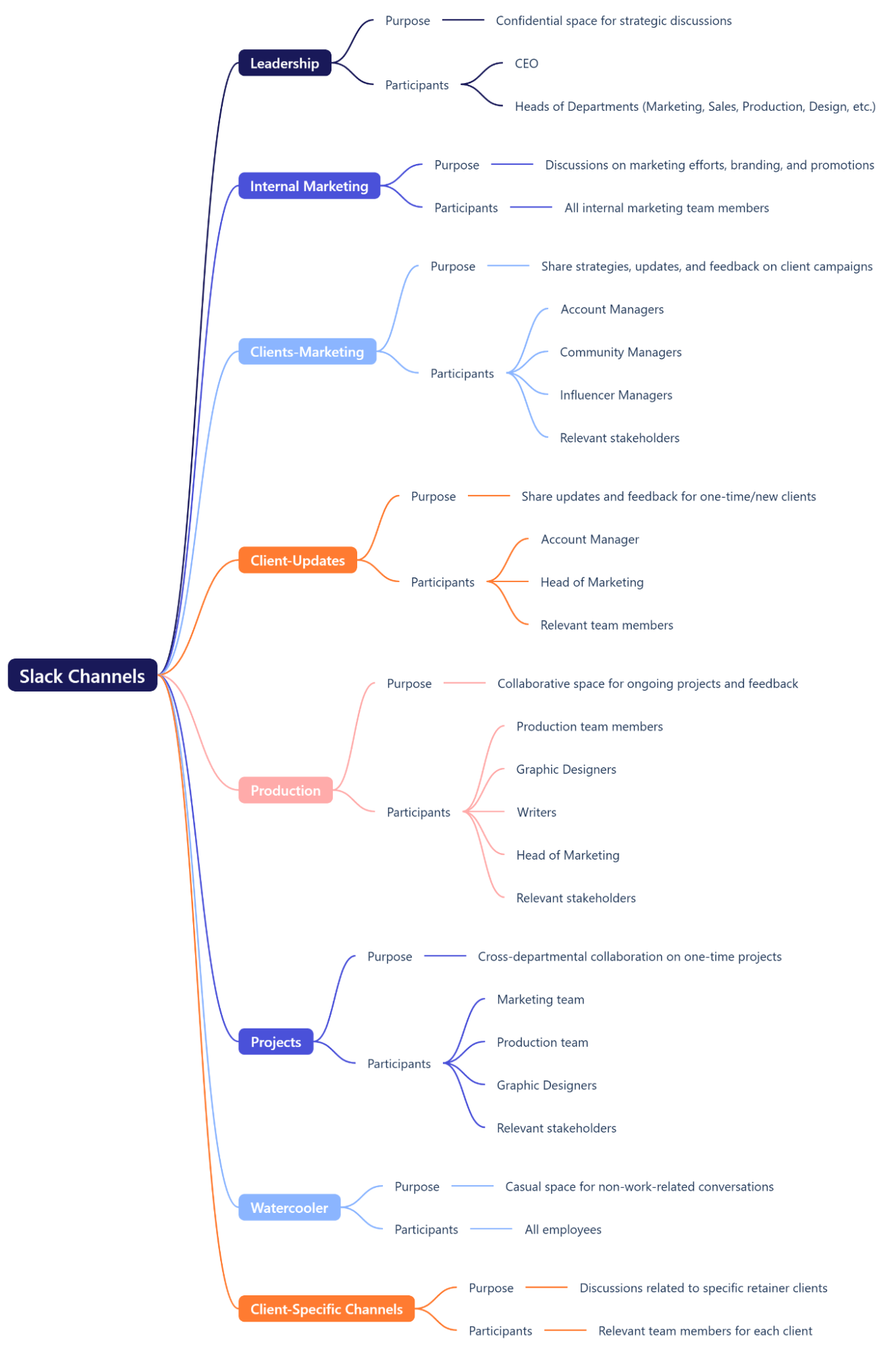
This shift aimed to improve collaboration and restore work-life balance, boosting morale.
Google Workspace – centralizing collaboration
Google Workspace was intended to replace a part of their notebooks through things like:
- Google Drive: Shared drives that ensure easy access and version control.
- Docs & Sheets: Real-time collaboration that eliminates delays.
- Calendar Integration: Streamlined scheduling and visibility.
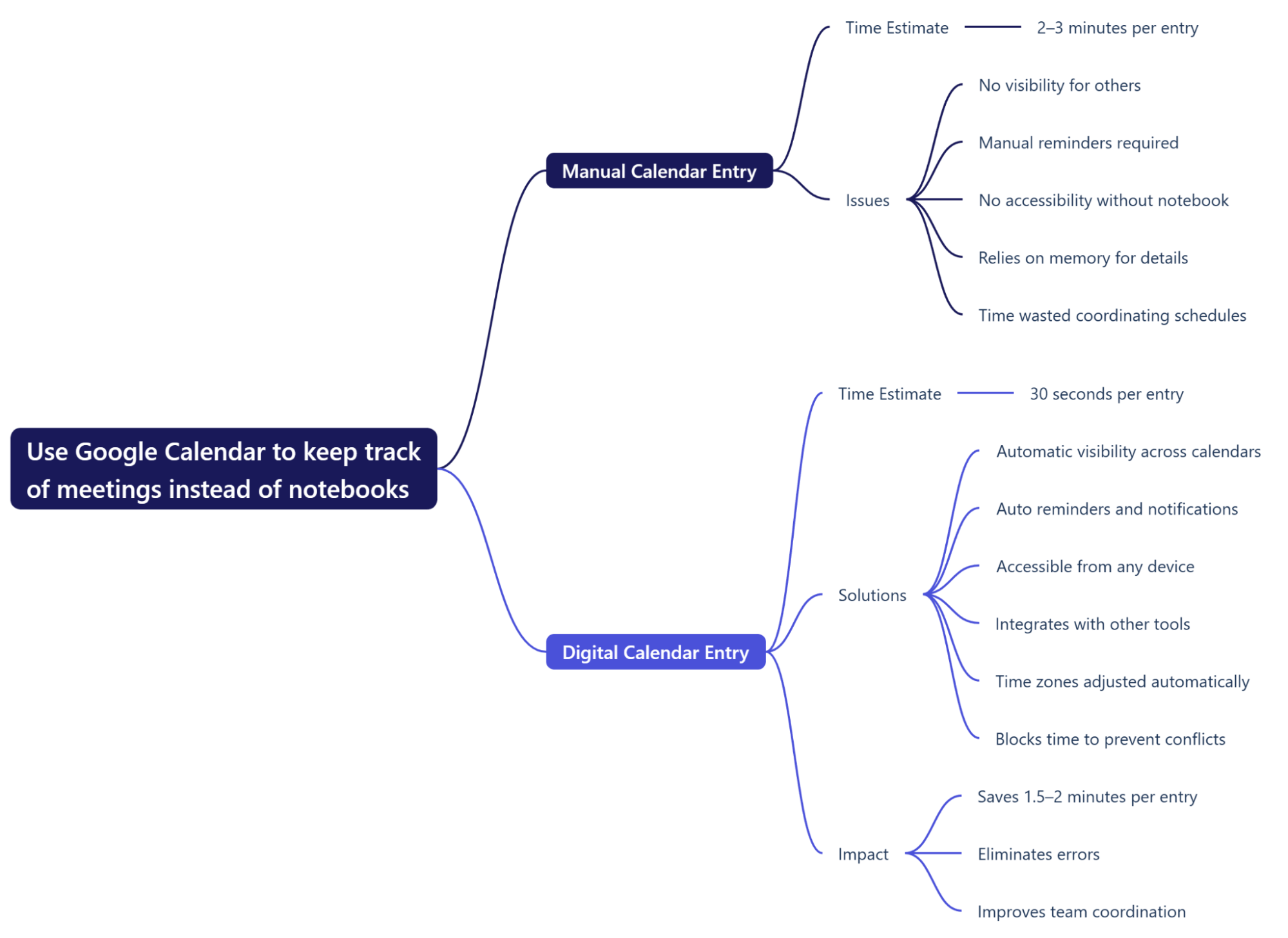
For instance, as shown in the mind map, replacing manual meeting tracking with Google Calendar can significantly improve efficiency. The shift reduces time spent on manual entries, eliminates errors, and enhances team coordination by providing automatic visibility and reminders. With these changes, their team could focus on delivering quality work, not hunting for data.
Below is a comparison between tracking meetings manually in a notebook, as was previously done, and utilizing Google Calendar:
ClickUp – organizing tasks and workflows
The other part of their notebooks would have been replaced with ClickUp, which allowed:
- Task templates: Standardized workflows for recurring tasks.
- Automations: Automatically assigning tasks and setting due dates.
- Dashboards: A bird’s-eye view of progress and workload.
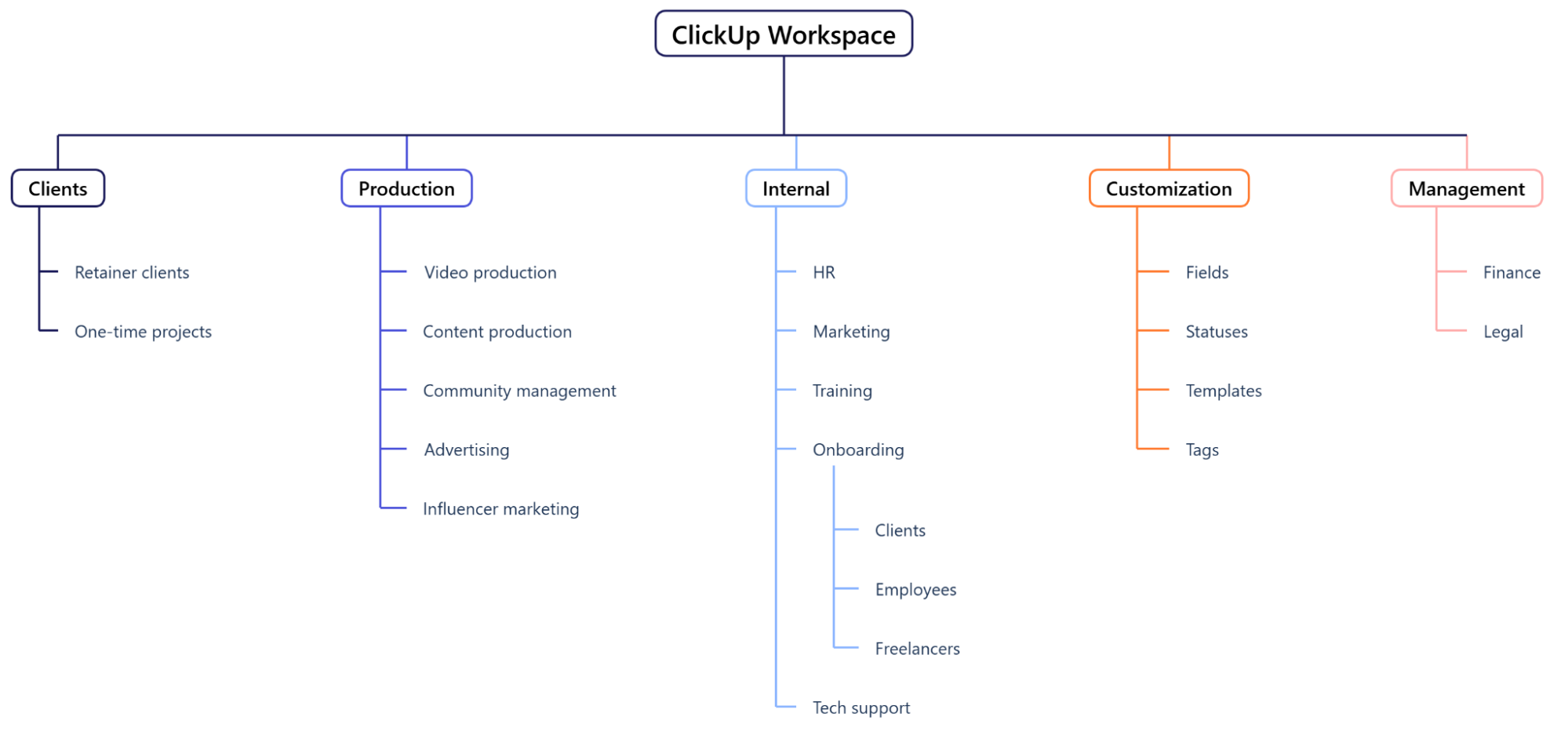
This structure eliminated bottlenecks and enabled proactive decision-making. Here is my suggestion for their their ClickUp Workspace:
Implementation: from ideas to action
Addressing the agency’s challenges required a dual approach: implementing scalable systems while empowering the people behind those systems. Here’s how I looked at the situation step by step, ensuring both operational efficiency and team empowerment:
Situation:
The agency was struggling with inefficiencies caused by manual processes, lack of workflow transparency, and operational bottlenecks. These issues not only lowered productivity but also left the team feeling overwhelmed and unsupported.
Task:
My goal was twofold:
- Create scalable systems to streamline operations and improve efficiency.
- Foster a culture of empowerment where team members could take ownership of their work and thrive in their roles.
Action:
To achieve these goals, I suggested the following steps:
- Transition to Slack for communication:
- Introduce structured channels for projects and clients, creating clarity and reducing communication overload.
- Use Slack’s huddles and threads to enable quick, on-topic discussions, fostering collaboration without interrupting workflows.
- Empower the team by giving them a centralized, searchable history of conversations, reducing dependency on managers for updates or context.
- Set up ClickUp for task and workflow management:
- Design task templates for recurring processes, ensuring consistency and efficiency.
- Automate task assignments and due dates, allowing team members to focus on execution rather than administrative overhead.
- Create dashboards that provide full visibility into workloads, empowering both team members and leadership to make proactive decisions.
- Implement Google Workspace for collaboration:
- Introduce shared drives for secure, centralized access to project files, eliminating the confusion of scattered documents.
- Enable real-time collaboration through Google Docs and Sheets, reducing delays and errors.
- Streamline scheduling with Google Calendar, ensuring everyone had visibility into meetings and deadlines.
- Involve the team in the process:
- Hold workshops to train team members on using the new tools effectively, ensuring they felt confident and supported.
- Collect feedback from the team throughout the implementation, fine-tuning the systems to meet their specific needs.
- Encourage open communication about challenges, fostering a sense of collaboration and ownership over the new processes.
Result:
The combined impact of these actions:
- Time saved: estimated reduced time spent on manual processes by over 10 hours per week per person, freeing up the team to focus on higher-value work.
- Improved task completion rates: standardize workflows to increase task completion rates by approximately 40%, ensuring deadlines were consistently met.
- Enhance accountability: transparent workflows and dashboards that empower team members to take ownership of their responsibilities, improving overall accountability.
- Boost team morale: the shift to modern tools and collaborative systems will reduce stress, improve work-life balance, and foster a culture of trust and empowerment.

Additional recommendations from past experience
Building on my prior experience, I provided further recommendations:
- For retainer clients:
- Use ClickUp Templates to create standardized workflows for monthly deliverables like content calendars and community management.
- Automate task assignments and due dates based on the production stages (e.g., “To Do,” “In Progress,” “Review”).
- For one-time projects:
- Organize tasks by client and project type in ClickUp, with custom fields to track deadlines, deliverables, and progress.
- Use Slack channels for project-specific communication, ensuring all updates and feedback are centralized.
- For influencer management:
- Create a dedicated folder in ClickUp to manage influencer sourcing, outreach, and campaign tracking.
- Use Google Sheets for initial data collection, then integrate it into ClickUp for task assignment and progress monitoring.
- For internal processes:
- Set up Google Workspace for HR, legal, and finance documentation, ensuring secure and centralized access.
- Use ClickUp’s time-tracking feature to monitor team workload and identify areas for improvement.
Empowering the team to thrive
One of the most significant goals of this project was to empower the team—not just to perform tasks but to excel in their roles. By addressing the operational chaos and introducing scalable systems, the team can experience a shift from firefighting to proactive ownership. Here’s how the proposal empowered the agency’s people:
Restoring focus and reducing stress:
With clear workflows and automated systems, team members no longer have to rely on memory or verbal updates to track tasks. This will reduce the mental load and give them the mental space to focus on delivering creative, high-quality work.
Fostering accountability and ownership:
Tools like ClickUp and Slack provide transparency into who was responsible for what. This clarity encourages team members to take ownership of their tasks, boosting individual accountability and fostering a sense of pride in their contributions.
Streamlining collaboration and communication:
By replacing WhatsApp with Slack and introducing Google Workspace, the team will have centralized platforms for communication and collaboration. This eliminates the frustration of searching for updates in scattered channels, enabling smoother teamwork and faster decision-making.
Empowering leaders to lead:
The owner and managers can finally step out of the weeds of micromanagement. With dashboards and automated reporting, they will gain a bird’s-eye view of operations, allowing them to focus on strategic initiatives and empowering their team to handle day-to-day responsibilities.
Creating a culture of excellence and growth:
Documented workflows and standardized processes will not only ensure consistent quality but also make onboarding new hires a smoother experience. New team members could ramp up quickly, contributing to a culture where everyone felt equipped and supported to succeed.
This cultural shift can transform the agency into a more empowered, collaborative, and efficient team, setting the stage for sustainable growth and innovation.
The results: measurable impact of scalable systems
By introducing these solutions, I aimed for the following results:
| Metric | Before implementation | After implementation | Improvement |
| Manual processes | Physical notebooks, verbal updates | Automated workflows with modern tools | Reduced by 70% |
| Time spent on admin work | 15+ hours/week on repetitive tasks | 5 hours/week with automation | Saved 10+ hours/week/person |
| Task completion rates | Inconsistent tracking, missed deadlines | Standardized workflows, higher completion | Increased by 30–40% |
| Workflow transparency | Minimal visibility | 100% visibility with dashboards | Full transparency achieved |
| Onboarding efficiency | No documentation; weeks-long onboarding | Documented workflows reduced time to productivity by 50% | Faster onboarding process |
These results prove the transformative impact of scalable systems and modern tools on team efficiency, transparency, and scalability.
Cost vs. benefit: the ROI of scalable systems
Implementing Slack, Google Workspace, and ClickUp, combined with expert operational leadership, is not just about improving workflows—it’s a smart investment in both time and money. Here’s how the costs stack up against the benefits:
First-year costs and savings
- Annual cost of tools: $1,920/year.
- My service fee: $80,000 (one-time cost for the year).
- Total cost (Year 1): $81,920.
- Time saved: 10 hours per week per team member, totaling 4,160 hours annually across 8 team members.
- Monetary value of time saved: $115,648/year (based on an average hourly rate of $27.80).
- Net savings (Year 1): $33,728/year.
- ROI (Year 1): 41.2%.
Subsequent years
- Annual cost of tools: $1,920/year.
- Ongoing maintenance (e.g., hiring a VA): Estimated at $20,000/year.
- Total cost (Years 2+): $21,920/year.
- Net savings (Years 2+): $93,728/year.
- ROI (Years 2+): 427.5%.
Details at a glance:
| Category | Details | Cost/Value (Year 1) | Cost/Value (Years 2+) |
| Tools implemented | Slack (Free), Google Workspace, ClickUp | $1,920/year | $1,920/year |
| My service fee | One-time implementation cost | $80,000 | $0 |
| Ongoing maintenance | VA or minimal upkeep based on SOPs | $0 | $20,000/year |
| Time saved | 10 hours/week × 8 team members | 4,160 hours/year | 4,160 hours/year |
| Average hourly rate | Based on team roles | $27.80/hour | $27.80/hour |
| Monetary value of time | Total time saved × hourly rate | $115,648/year | $115,648/year |
| Net savings | Monetary value − tool costs | $33,728/year | $93,728/year |
| ROI | Net savings ÷ tool costs × 100 | 41.2% | 427.5% |
Beyond the numbers:
This isn’t just about dollars and hours. The implementation also provides significant intangible benefits:
- Boosts team morale: Reduces stress and improves work-life balance by replacing chaotic, manual processes with clear, automated workflows.
- Enhances client satisfaction: Deliverables become more consistent, timely, and aligned with the agency’s brand promise.
- Prepares for growth: Scalable systems ensure the agency can expand without operational bottlenecks, setting the stage for long-term success.
- Empowers leadership: Leaders can focus on strategic growth initiatives instead of micromanaging daily operations.
By investing $81,920 in the first year, the agency not only unlocks $115,648 in value but also sets the stage for even greater long-term returns. In subsequent years, with only minimal maintenance costs (e.g., hiring a VA for $20,000/year), the agency will enjoy net savings of $93,728 annually and an ROI of 427.5%. This demonstrates how operational efficiency and empowerment generate sustained value over time.
Lessons learned: empowering teams to thrive
This project reinforced a key lesson: tools alone don’t solve problems—people do. By involving the team and aligning systems with their needs, I aim to turn chaos into clarity.
Scaling isn’t just about implementing tools. It’s about creating a culture of empowerment, accountability, and excellence.
 Alex Gita | Driving Efficiency, Empowering Teams